What the book is
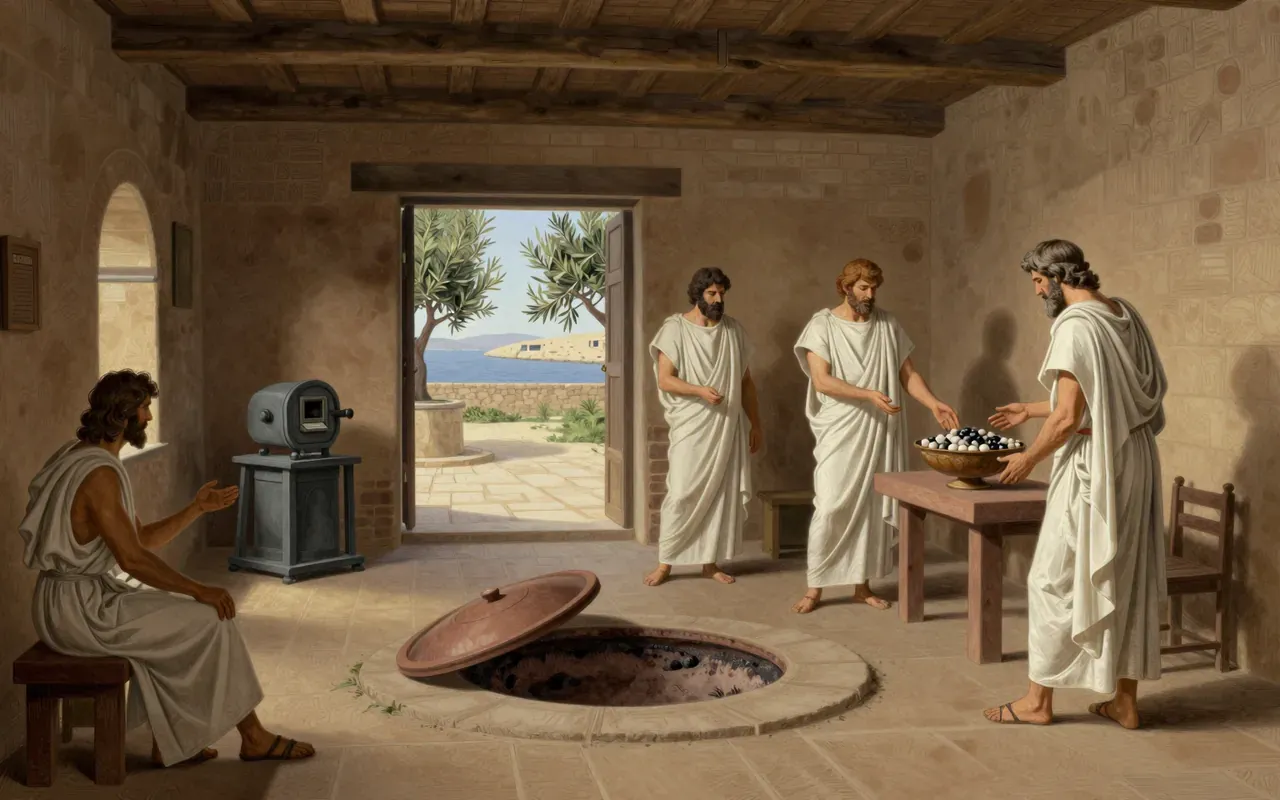
A dialogue set in Piraeus, where Socrates debates justice with Cephalus, Polemarchus, Thrasymachus, Glaucon and Adeimantus across ten books. It is not a treatise but a performed philosophical experiment: characters speak, interrupt, concede, and resist. The city-in-speech is built step by step, then dismantled and rebuilt.
The main ideas
Justice is each part doing its proper work: reason over spirit and appetite in the soul, rulers over auxiliaries and producers in the state. The soul ascends from shadow to sun via mathematics and dialectic. Poetry imitates appearances and weakens reason. Tyranny arises from excess freedom. The soul is immortal and chooses its next life after death.
What works
The allegory of the Cave crystallises the entire argument in one image: prisoners chained, shadows on a wall, the painful turn toward light. The tripartite soul gives psychology its first structural model. The critique of imitation in Book X remains the sharpest attack on representational art ever made.
What does not
It does not hold together as a political blueprint. The community of wives collapses under its own logic: if children are common, parentage is unknowable, yet Socrates insists guardians must avoid breeding with parents or siblings. The philosopher-king demands absolute power to enforce censorship, yet offers no mechanism to prevent his corruption—only hope he will descend reluctantly from the Good.
The themes
The book turns on the tension between truth and appearance, reason and desire, education and coercion. Its central motif is the tripartite division—of soul, state, and cognition—and the violence required to maintain its hierarchy. The Cave is not metaphor but method: all knowledge begins in chains.
Who should read it
Readers who want to see how foundational Western ideas about justice, education and the soul were first argued—not assumed. Those studying political theory, ethics or classical philosophy must engage with Book IV’s definition of justice, Book VII’s Cave, and Book X’s critique of poetry.
Who should not
Readers seeking a practical guide to governance. The Republic rejects democracy outright in Book VIII. It offers no institutions, no constitution, no transition plan—only a single condition: philosophers must rule, or all is lost.
The assessment
The Republic argues that justice is harmony: the soul’s reason ruling spirit and appetite, mirrored in the state by philosopher-kings ruling guardians and producers. It fails when it treats women as interchangeable with men in training but then excludes them from dialectic; when it bans Homer for corrupting courage yet uses myth—the Cave, the Sun, the Myth of Er—to do its deepest work; when it claims poetry is thrice removed from truth but builds its entire argument on poetic images.
Is it worth your time
Yes—if you read it as Plato intended: aloud, in dialogue, with attention to who speaks and when. Skip the digressions on musical modes in Book III. Do not read Book V’s breeding programme as policy; read it as reductio ad absurdum of functionalist logic.