What the book is
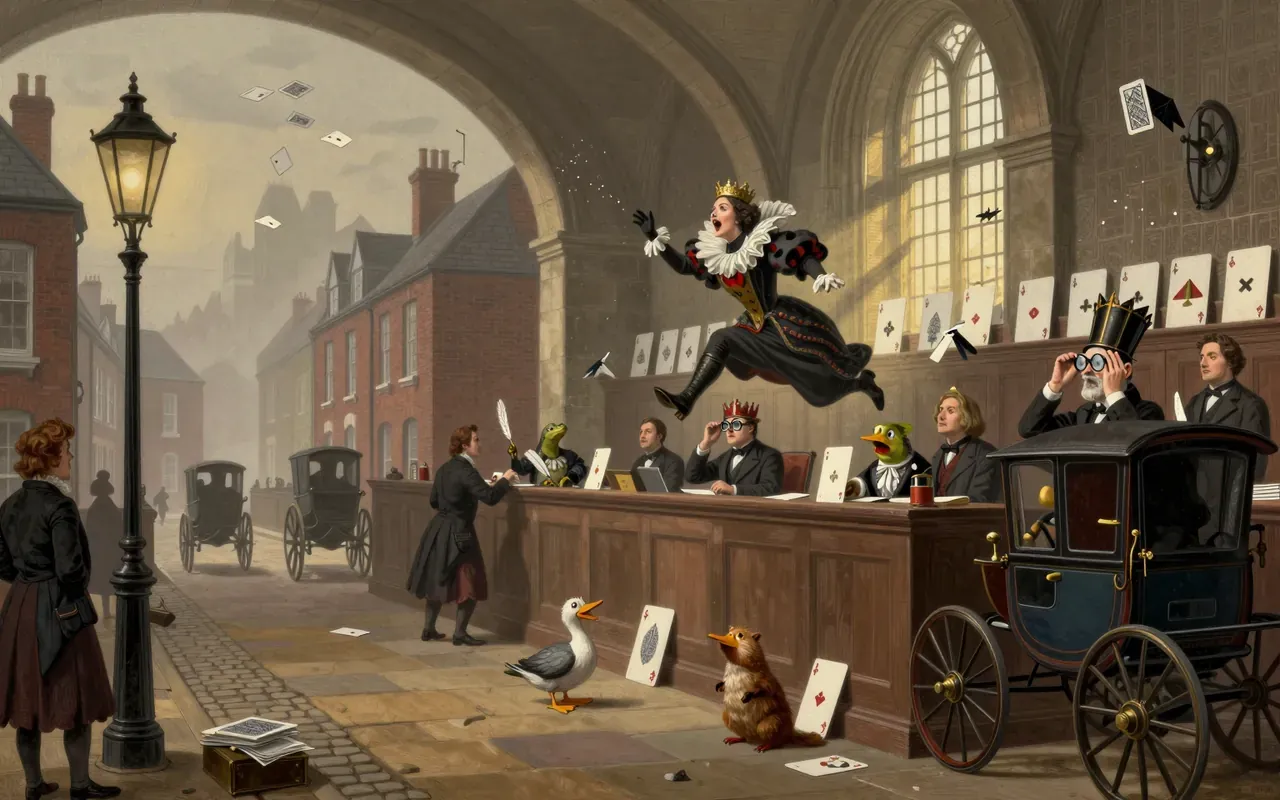
A dream-narrative in which seven-year-old Alice falls into a world where physics, grammar and law obey no shared rule. She shrinks after eating ‘DRINK ME’, grows after eating ‘EAT ME’, weeps a swimming pool (Ch. I), survives a pepper-choked kitchen (Ch. VI), endures a stalled tea-party (Ch. VII), and testifies at a trial for stolen tarts (Ch. XI). The book ends when she declares the Queen ‘a pack of cards’ (Ch. XII) and wakes.
The main ideas
It uses shrinking and growing to dramatise loss of control over self and world. It treats language as unstable: ‘Curiouser’ (Ch. II), mangled recitations (Ch. X), and the Cat’s mad logic (Ch. VI) all break grammar to expose meaning as contingent. It frames authority as arbitrary: the Queen’s edicts (Ch. VIII), the trial’s rules (Ch. XI), and the Duchess’s morals (Ch. IX) are enforced without reason or consistency.
What works
The Cheshire Cat’s definition of madness (Ch. VI) is tight, logical, and devastating. Alice’s interruption of the Queen (‘Nonsense!’, Ch. VIII) is the first crack in Wonderland’s authority. The mushroom’s dual sides (Ch. V) make growth a choice, not fate. Her final line—‘You’re nothing but a pack of cards!’ (Ch. XII)—is earned, specific, and irreversible.
What does not
It does not sustain emotional stakes beyond Alice’s shifting size. The Duchess’s cruelty (Ch. VI) has no consequence. The Queen’s threats lack weight because no one fears them—not even the gardeners (Ch. VIII). The Hatter’s riddle (Ch. VII) is unsolvable by design, not insight. The Gryphon’s dismissal of executions (Ch. IX) undercuts moral tension. Nothing in Wonderland changes except Alice—and only physically, until Ch. XII.
The themes
Absurdism is the engine: Wonderland runs on contradiction, not metaphor. Childhood is not innocence but negotiation—Alice corrects grammar, challenges verdicts, and names lies. Language is a tool that misfires: ‘No room!’ (Ch. VII) is both refusal and spatial lie. Power is performative: the King spectacles up (Ch. XI), the Queen shouts ‘Off with her head!’ (Ch. VIII), but neither acts without Alice’s presence to animate it.
Who should read it
Readers who want to see logic dismantled with precision and glee. Anyone studying how children’s literature weaponises nonsense against adult certainty. Linguists interested in semantic collapse: ‘Curiouser’ (Ch. II), ‘Uglification’ (Ch. IX), and the Cat’s syllogism (Ch. VI) are deliberate fractures in English.
Who should not
Readers seeking psychological realism: no character develops beyond Alice’s final defiance. Those needing moral resolution: the Knave is never convicted, the Queen unpunished, the baby-pig unaccounted for. Readers allergic to repetition: the phrase ‘Off with his head!’ appears eleven times across Ch. VIII–XII, always void of consequence.
The assessment
The book argues that logic, language and authority collapse under scrutiny—and that childhood selfhood is forged in resisting them. It fails when it leans on Victorian pedantry for satire without grounding its absurdity in character. The trial scene (Ch. XI–XII) is the climax: Alice’s final line—‘You’re nothing but a pack of cards!’—is the book’s thesis made flesh. The Caucus-Race (Ch. III) and Lobster Quadrille (Ch. X) are pure structural nonsense, not ideas. The Mock Turtle’s ‘Uglification’ lessons (Ch. IX) parody curriculum, not education itself.
Is it worth your time
Yes—if you read it as linguistic and political satire, not whimsy. Skip Ch. IV’s Duchess moralising (she forces ‘Everything’s got a moral’, Ch. IX) and Ch. V’s extended ‘Beautiful Soup’ song (Ch. X), which adds rhythm but no argument. Read Ch. I, VI, VII, VIII, XI and XII straight through: they contain every idea the book defends.