What the book is
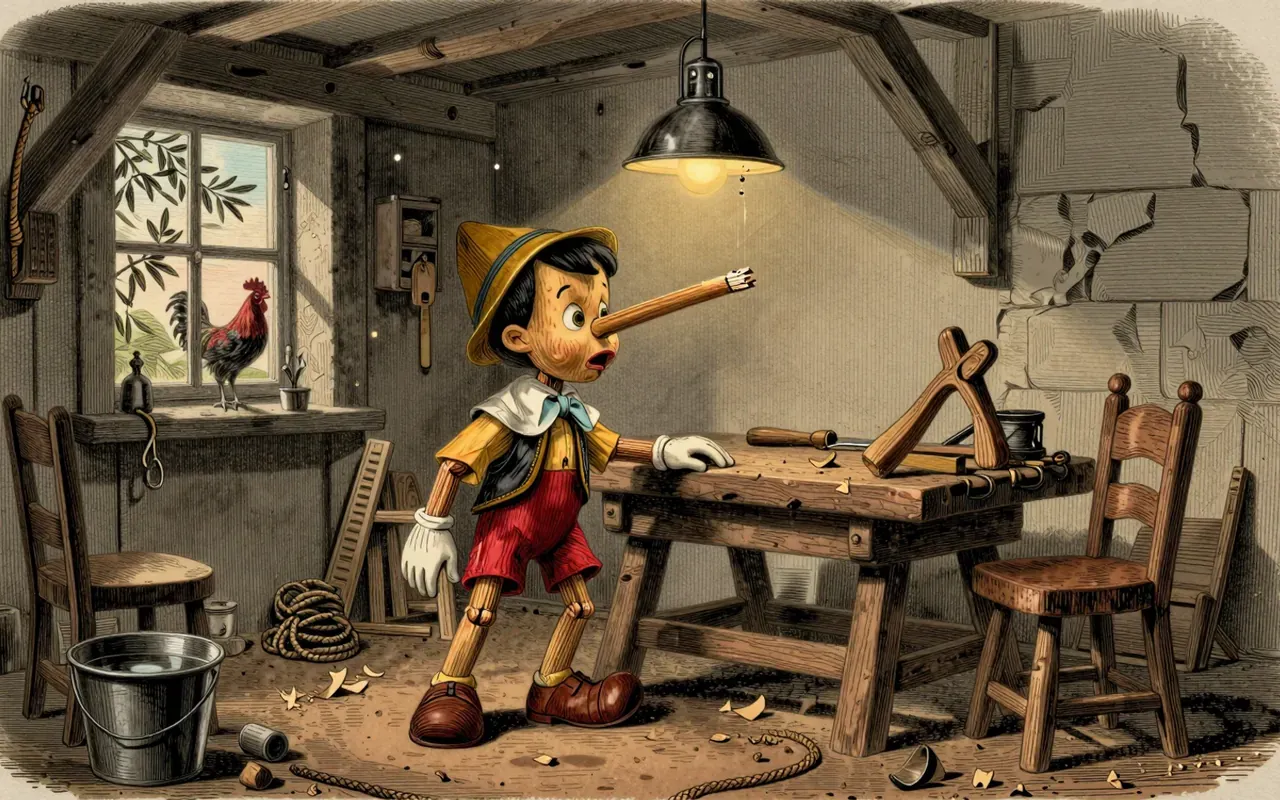
A serialized 1883 Italian children’s novel, originally published in Il Giornale per i Bambini. It follows a sentient piece of wood carved by Geppetto into Pinocchio, a puppet who repeatedly disobeys, suffers grotesque physical consequences, and—only after surviving the Dog-Fish and nursing his father—is transformed into a real boy.
The main ideas
Moral failure produces immediate physical mutation: lying lengthens the nose, skipping school grows donkey ears. The Fairy’s interventions are surgical, not nurturing—she saves Pinocchio from fire, then lets him be sold as a circus donkey. The Dog-Fish is both tomb and womb: Pinocchio finds Geppetto alive inside its belly, eating live fish that leap from his mouth. Virtue is proven only in action: giving five dollars to the ill Fairy, carrying Geppetto through seawater.
What works
The Dog-Fish sequence is unmatched: Pinocchio discovers Geppetto alive inside, eating live fish that jump from his mouth. The ‘Land of Boobies’ is a precise satire of anti-education rhetoric—its slogans are misspelled, its logic seductive, its outcome inevitable. Pinocchio’s final act—giving his five dollars to the ill Fairy—is quiet, unsentimental, and decisive.
What does not
The ‘Land of Boobies’ collapses into caricature. Its slogans are spelled badly on walls, its logic is pure satire—but the book never interrogates why boys choose it, or how power operates there beyond flattery. Candlewick vanishes after Chapter XXXII. The Fox and Cat reappear unscathed. The moral machinery runs on punishment, not insight.
The themes
The book treats childhood as a site of irreversible consequence. Not metaphorical growth, but literal metamorphosis: wood to puppet, boy to donkey, donkey to corpse-to-be. Responsibility is bodily: Pinocchio carries Geppetto on his shoulders out of the Dog-Fish. The Fairy’s blue hair recurs like a liturgical colour—her presence signals intervention, not forgiveness. Play is weaponised: ‘Long live playthings, we will have no more schools’ is written in charcoal, misspelled, on every wall.
Who should read it
Readers who want moral fiction that refuses consolation. Teachers studying Victorian-era didacticism. Anyone who needs proof that ‘consequences’ can be rendered with anatomical precision: donkey ears, braying, a tongue thick enough to walk across inside a monster.
Who should not
Parents seeking gentle bedtime stories. Readers who expect character arcs built on introspection rather than bodily violation. Anyone allergic to literalised allegory: this is not ‘symbolic’—the nose grows, the ears sprout, the skin is sold for drums.
The assessment
Pinocchio is not a children’s fable about honesty. It is a brutal, literalised moral calculus: disobedience deforms the body, idleness turns you into livestock, and redemption arrives only after irreversible degradation. The Dog-Fish is not a plot device but a stomach—dark, wet, suffocating—and inside it, Geppetto survives on live fish that jump from his mouth. The Fairy’s mercy is conditional, delayed, and mediated by suffering. There is no grace without labour, no transformation without prior annihilation.
Is it worth your time
Yes—if you read Chapters I, XXXI–XXXVI straight through and skip the Fox and Cat’s second scam (Ch. XXVIII–XXIX) and the entire circus training sequence (Ch. XXXIII), which repeats the same humiliation without deepening it.