What the book is
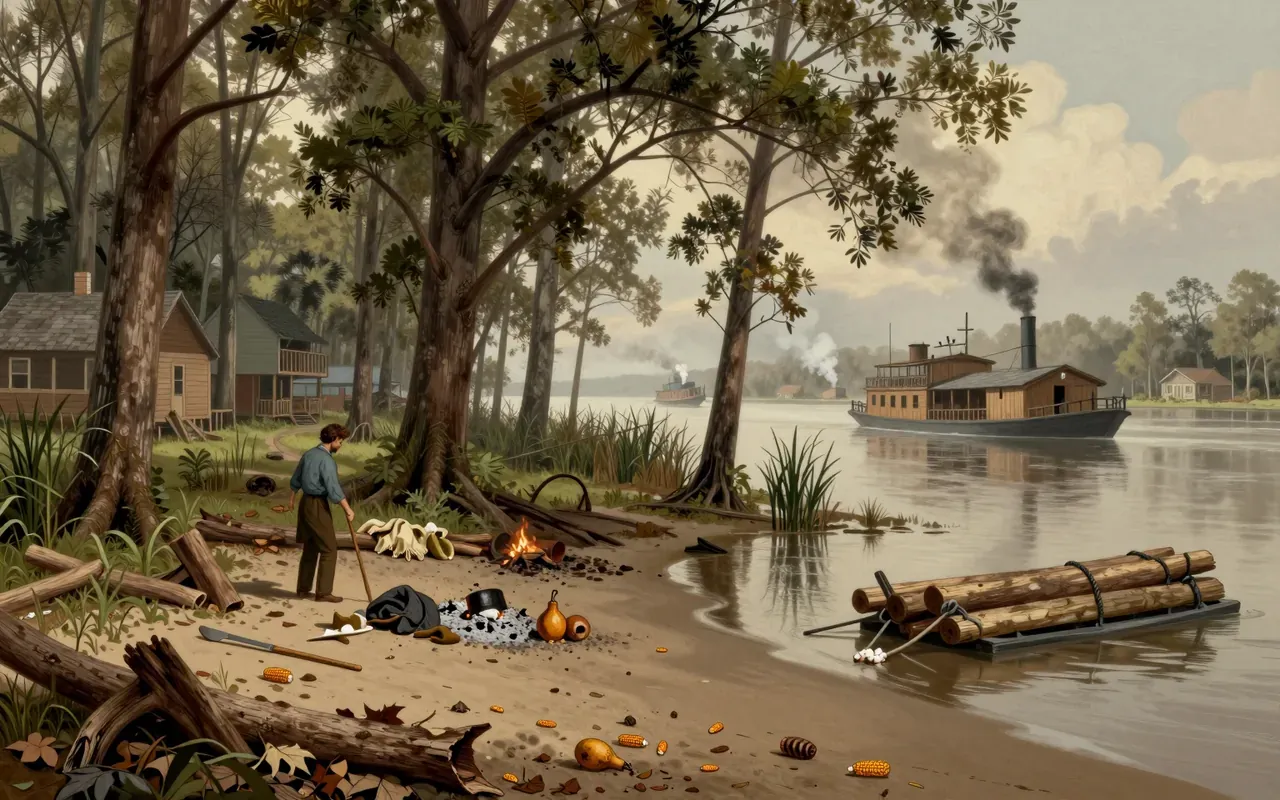
A picaresque novel set on the Mississippi River ‘forty to fifty years ago’, following Huck Finn’s flight from his abusive father and his alliance with Jim, an enslaved man fleeing sale downriver. It is structured as a series of episodes—Jackson’s Island, the Grangerfords, the duke and king, the Wilkses, the Phelps farm—each exposing a different facet of Southern moral failure.
The main ideas
Huck’s moral development is charted in concrete decisions: rejecting Pap’s abuse, choosing Jim over religion in Chapter XXXI, and refusing adoption at the end. Jim’s humanity is shown in action—not speech—nursing Tom despite chains, insisting on medical care, and recalling the floating house where Pap died. The Grangerford-Shepherdson feud (Chapter XVIII) and the duke and king’s scams (Chapters XIX–XXVII) are not digressions—they are structural parallels showing how hierarchy, whether inherited or invented, justifies cruelty.
What works
The raft scenes (Chapters XV–XVI) are unmatched: Huck and Jim’s quiet routines, the storm, the wrecked steamboat—all built on observation, not exposition. The Grangerford-Shepherdson feud (Chapter XVIII) delivers its horror through understatement: Q3’s dry recitation of escalation makes the bloodshed feel inevitable, not sensational. Huck’s lie to Aunt Sally (Q13) works because it’s small, urgent, and morally ambiguous—no grandstanding, just survival.
What does not
It fails when Tom takes over in Chapters XXIX–XLII. His romanticized, rule-bound ‘adventure’ reduces Jim to a prop. The Wilks fraud works because it targets greed and gullibility; Tom’s scheme targets nothing but his own ego. Chapter XLII’s revelation lands with irony, not catharsis, because the reader has already seen Jim’s dignity eroded for weeks.
The themes
Race is not a backdrop but the engine: every major plot turn hinges on Jim’s status as property. Hypocrisy is embodied in the Widow Douglas’s Bible lessons while she owns slaves, in the mob’s cowardice when confronted with real violence (Q4), and in Tom’s ‘elegant’ plan (Q12) that risks Jim’s life for spectacle. Freedom is physical and geographical—the raft, the fog, missing Cairo—but also psychological: Huck’s final line (Q22) names ‘sivilization’ as the true prison.
Who should read it
Readers who want to see how satire dismantles ideology through character and incident, not argument. Those who recognise that Q7—‘All right, then, I’ll go to hell’—is not a moment of doubt but of hard-won certainty. Anyone studying how dialect functions as ethical register, not ornament.
Who should not
Readers who expect consistent narrative control: Tom’s takeover in Chapter XXIX abandons Huck’s voice and moral authority. Those who need racial dynamics handled with modern framing will find the n-word frequent and unmediated—it appears in Q2, Q12, Q17, Q18, and throughout the text as social fact, not authorial commentary.
The assessment
The book argues that moral clarity emerges not from society’s rules but from direct human contact—and that Southern ‘civilization’ is a fraud sustained by violence and self-deception. It does this through Huck’s choices: faking his death to escape Pap, hiding with Jim on Jackson’s Island, stealing the Wilks inheritance to protect Mary Jane, and tearing up the letter to Miss Watson in Chapter XXXI. The final revelation—that Jim was already free—exposes Tom’s entire rescue as cruel theatre.
Is it worth your time
Yes—if you read Chapters I–XVI and XXX–XLII straight through, skip Chapter XL (the botched rescue), and treat Tom’s ‘elegant’ plan (Q12) as the book’s deliberate indictment, not its climax. The core argument is complete by Chapter XXXI. Everything after is diagnosis, not development.