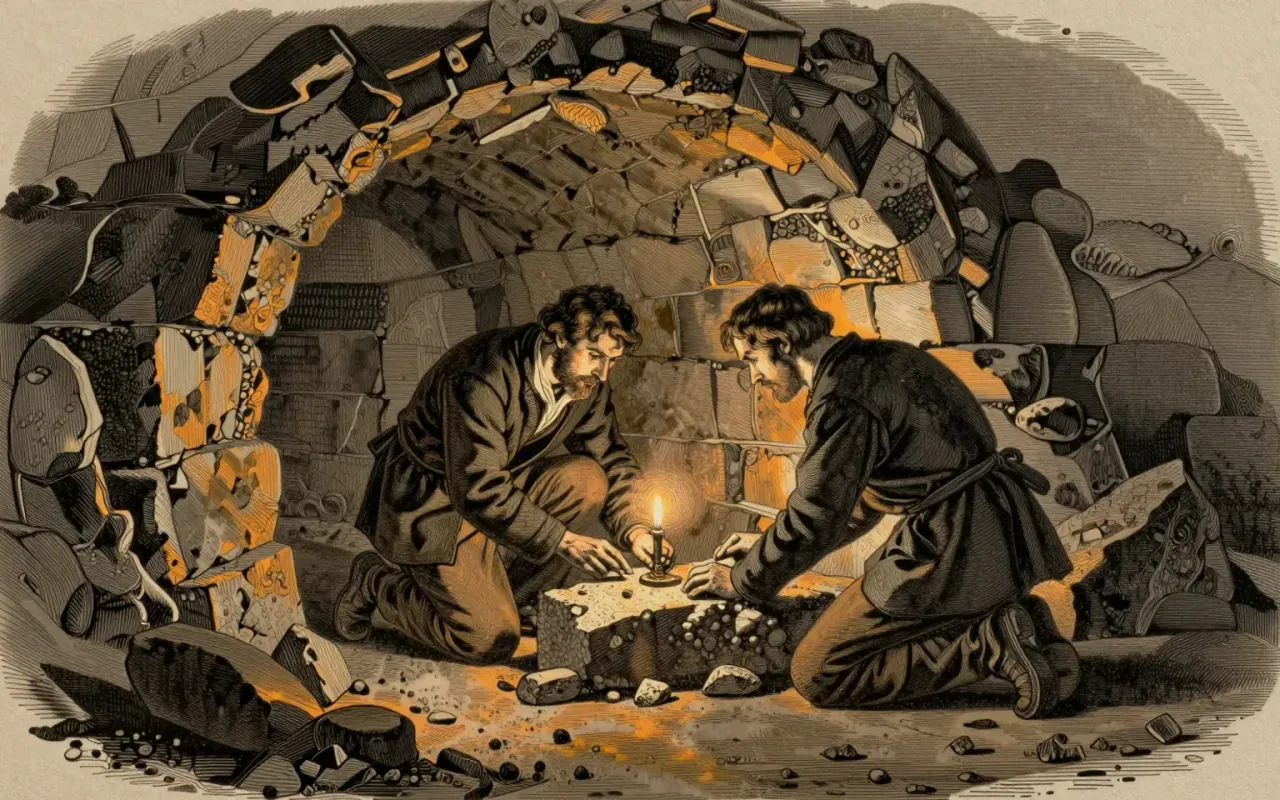
A bombardier is trapped by a military rule that says you can't refuse to fly if you're sane enough to ask.
Heller's 1961 novel follows Yossarian, whose only escape from deadly bombing runs is to convince a doctor he is mad. The catch: anyone sane enough to ask is sane enough to fly. It is a circular trap, and the book is built to prove it.
Yossarian wants out. The only way out is to be insane. But asking means you understand the danger, which proves you are sane.
2:15
The squadron
Nobody makes sense. Authority, loyalty, careerism—all are performative masks over chaos.
5:30
The circularity
Every rule contains its own contradiction. Every solution creates the problem it tries to solve.
9:00
The ending
Yossarian's escape is not a triumph. He runs toward an institution as corrupt as the one he fled.
Worth your time?
Selectively. Start with the brief, then read the parts we point at.
4/ 5
What works
The structure mirrors the logic trap. Reading it is the experience of being trapped.
The dialogue is sharp and often funny in a way that feels dangerous.
What does not
The repetition exhausts. Heller proves his point by the halfway mark.
Some sections drag without adding to the argument or the comedy.
Read it if
Readers who can handle a novel that circles rather than climbs
Anyone interested in how dark comedy and structure intersect
Skip it if
Those who need linear plots or clear resolutions
Readers seeking uplift or moral clarity
The written brief1 min read
What the book is
Heller’s 1961 novel set on a Mediterranean island during the final months of World War II. Yossarian, a bombardier, navigates absurd military bureaucracy and the catch-22 that makes escape impossible: to be grounded for insanity, he must ask the doctor to ground him, which proves he is sane.
Is it worth your time
Selectively. Read it if you want to understand how a novel can be a philosophical trap. Read it if satire is your language. Skip it if you cannot afford 450 pages of circles.