booksbriefs
14:46in productionCh. 1 · The manager's curtain/ 14:46 · ceiling 15 min
Literary fiction

Vanity Fair

William Makepeace Thackeray · 0 · 699 pages → 14 min 46 s

Vanity Fair is not a critique of vanity—it is vanity’s operating manual.

Vanity Fair is a satirical novel that treats society as a rigged theatre. It contrasts Becky Sharp’s ruthless self-invention with Amelia Sedley’s passive virtue, exposing class, inheritance and performance as the real engines of power. The brief explains why its irony works, where it grows repetitive, and which chapters deliver its sharpest insights.

Chapters & takeaways6
  1. 0:42
    The manager's curtain

    The Manager frames the whole novel as a staged performance where characters are puppets and morality is optional.

  2. 2:30
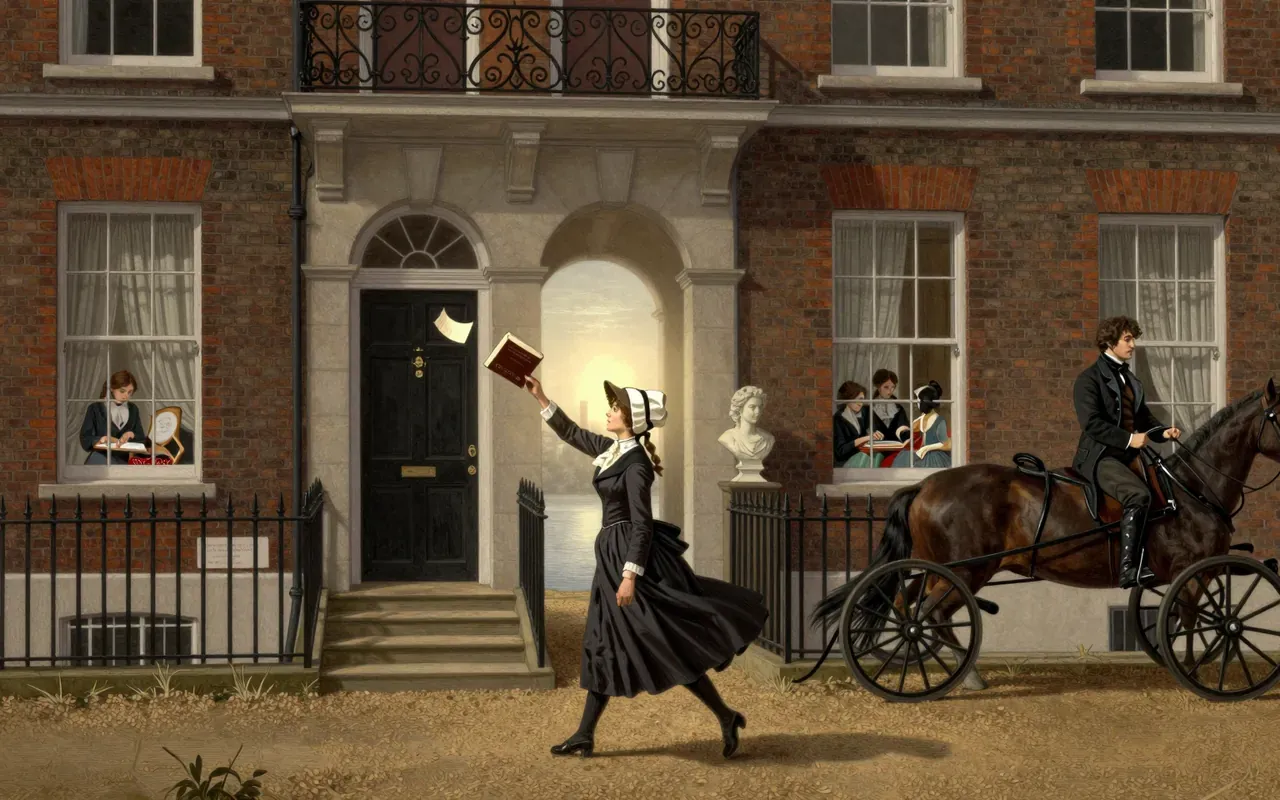
    Two exits from miss pinkerton's

    Becky Sharp weaponises intelligence and performance; Amelia Sedley embodies virtue so passive it becomes complicit.

  3. 4:31
    Inheritance and Waterloo

    Money fractures families: Miss Crawley’s seventy thousand pounds turns brothers into spies, and war reveals who performs courage and who buys horses to flee.

  4. 7:07
    Gaunt house and temple bar

    Becky’s court presentation and Rawdon’s arrest happen in the same hour—the triumph and collapse are structurally inseparable.

  5. 9:03
    Dobbin's unwavering gaze

    Dobbin’s devotion is the novel’s only unperformed feeling—and it is punished, delayed, then rewarded only after he abandons it.

  6. 10:50
    What to skip

    Skip Chapters XLIII–XLIX unless you need to see Becky sing at Gaunt House twice. The moral architecture is complete by Chapter XLII.

Worth your time?

Yes. Read the whole thing.

4.5/ 5
What works
  • The Manager’s theatrical frame holds every scene with surgical precision.
  • Becky Sharp remains one of fiction’s most coherent, unsentimental studies in survival.
  • The war scenes dissect masculinity in three modes: Jos’s flight, George’s neglect, Becky’s profiteering.
What does not
  • It gives Amelia no inner life beyond maternal devotion or grief.
  • It reduces Jos Sedley to a single note: cowardice and self-delusion.
  • It repeats its central diagnosis—vanity as system—without deepening it after Chapter XX.
Read it if
  • Readers who want a forensic study of social climbing in 1840s Britain.
  • Those who value irony that sustains its mask for six hundred pages.
  • Students of narrative framing: the Manager’s voice is the novel’s true protagonist.
Skip it if
  • Readers who expect psychological realism or moral resolution.
  • Those who dislike irony that never winks or breaks character.
  • Anyone seeking plot momentum—the novel moves by social consequence, not event.
The written brief2 min read

What the book is

A 1848 satirical novel framed as a theatrical performance overseen by a melancholy Manager. It follows Amelia Sedley and Becky Sharp from Miss Pinkerton’s academy through Waterloo, Paris, India and Pumpernickel, charting their divergent paths in a world governed by rank, wealth and appearance.

The main ideas

The novel dismantles the Victorian ideal of feminine virtue by contrasting Amelia’s passive goodness with Becky’s active survival. It exposes inheritance as social warfare: Miss Crawley’s seventy thousand pounds fractures the Crawley brothers. It treats marriage as transactional—George’s engagement, Rawdon’s elopement, Becky’s court presentation—all timed to financial or social necessity.

What works

The Manager’s framing device holds the entire structure: every character is a puppet, every scene a set piece. Becky Sharp is one of literature’s most sustained studies in strategic self-invention—her dictionary-fling in Chapter II defines her. The war scenes expose cowardice (Jos), neglect (George), endurance (Amelia) and opportunism (Becky) in the same breath.

What does not

It fails to grant Amelia interiority beyond suffering. It treats Jos Sedley as caricature, not character. It repeats the same moral diagnosis across six hundred pages without deepening it—Becky’s performance, Osborne’s pride, Dobbin’s patience are all established by Chapter XX and reiterated until Chapter LXVII.

The themes

Class is the engine: Queen’s Crawley’s decay, Gaunt House’s exclusivity, Whitefriars School’s hierarchy. Performance is the method: Becky’s charade, Mrs. Bute’s medical alarmism, the Manager’s curtain speech. Vanity is the substance: Osborne’s grief over George is inseparable from his wounded pride; Amelia’s love for Georgy is inseparable from her need for purpose.

Who should read it

Readers who want a precise anatomy of social climbing, hypocrisy and performative virtue in the early Victorian era. Those who recognise that satire works best when it names the exact mechanism—like Q5’s ‘silent battles for reversionary spoil’—and does not abstract it.

Who should not

Readers who expect psychological realism or narrative momentum. Those who require moral clarity: the book refuses to condemn Becky outright or exalt Amelia unconditionally. Those allergic to irony that never breaks character—even the narrator’s ‘melancholy’ is part of the act.

The assessment

Vanity Fair argues that society is a rigged theatre where virtue is costume and morality is stage direction. It names names: Becky Sharp’s dictionary-flinging exit from Miss Pinkerton’s, Rawdon’s cigar under Temple Bar, Amelia’s prayers in Brussels while Waterloo rages. The book’s irony is structural—not rhetorical—and its satire lands because it never lets a single character escape consequence or self-deception.

Is it worth your time

Yes—but read it in segments, not straight through. Skip Chapters XLIII–XLIX if you’ve grasped Becky’s court triumph and Rawdon’s arrest. The emotional core is Chapters XXXV–LXVII: Osborne’s death, Amelia’s reconciliation, Dobbin’s departure and return.
Same shelf · Literary fiction4 of 49
13:56
Adventures of Huckleberry FinnMark Twain · 0The book argues that moral clarity emerges from direct human contact, not society’s rules—and that Southern 'civilization' is a fraud sustained by violence and self-deception. It does this through Huck’s choices: faking his death, choosing Jim over religion, and rejecting adoption. Tom’s elaborate rescue is exposed as cruel theatre. Read Chapters I–XVI and XXX–XLII. Skip Chapter XL.
14:38
The Adventures of Tom Sawyer, CompleteMark Twain · 1910Twain’s 1876 novel treats childhood as a site of real moral risk—not innocence, not corruption, but constant negotiation. Tom’s fence-whitewashing, blood oath, courtroom testimony and cave ordeal are not adventures but ethical trials. The book works best in its sharpest scenes: Ch. II, XX, XXXI and XXXIII. Skip the editor’s introduction and the slower interludes.
16:43
The Awakening, and Selected Short StoriesKate Chopin · 0Chopin’s 1899 novel argues that self-ownership is lethal for women in patriarchal society—and shows it through Edna Pontellier’s physical, irreversible awakening and drowning. The selected stories reinforce this with figures who cross thresholds (La Folle), cling to ruins (Ma’ame Pélagie), or lose identity to war (Edmond). Skip the editor’s introduction. Read the novel straight through, then 'La Folle' and 'The Locket'.
13:42
Barren GroundEllen Anderson Gholson Glasgow · 1925Barren Ground rejects romantic redemption. It follows Dorinda Oakley from betrayed youth to stoic middle age, arguing that endurance—not love—is the land’s only reward. The book’s power lies in its refusal of catharsis: Jason’s ruin is physical erasure, not tragedy; Dorinda’s grief is for love she never had, not love she lost.
Up next in Books

Verses and Translations

Charles Stuart Calverley · 0 · 15:06

Victorian light verse isn’t frivolous—it’s a scalpel for class, gender and education.

15:06