A man chases impossible dreams and demolishes himself pursuing them, and the book is funnier and crueler than you expect.
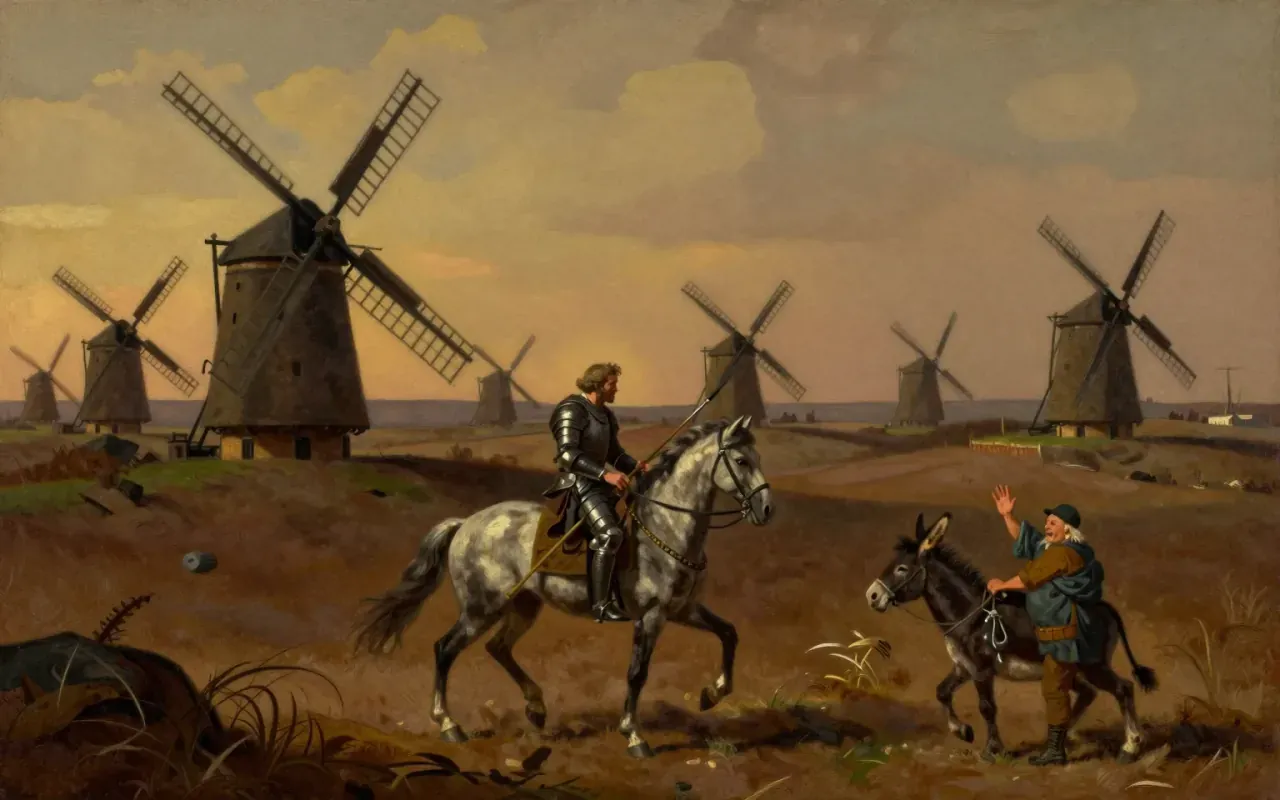
Cervantes's 1605 novel follows Don Quixote, a minor Spanish nobleman driven mad by chivalric romances who sets out as a knight-errant with his servant Sancho. The brief covers the opening madness and the machinery of the book, what makes it a satire of narrative itself, and which parts can be skipped.
Quixote has read so many chivalric romances that he believes he is a knight-errant, renames himself, acquires a broken horse, and sets out to right wrongs that do not exist.
3:30
The satire
The joke is not on Quixote's delusion but on chivalric literature itself. Cervantes exposes the genre as empty, repetitive, and dehumanizing by taking it absolutely literally.
6:00
Sancho and his master
The contrast between Quixote's refined madness and Sancho's crude sanity is the book's engine. Sancho speaks truth; Quixote speaks romantic nonsense. They need each other.
8:00
The machinery
The book contains poems, letters, interpolated novels, and nested stories. What seems like digression is structural; the interruptions are the point.
10:30
What to read
Part One, 1605, is brilliant. Part Two, 1615, is longer and less sharp. You can stop after Book Four of Part One and miss nothing that matters.
Worth your time?
Selectively. Start with the brief, then read the parts we point at.
3.5/ 5
What works
The satire is genuinely original: it invents a new genre by demolishing the old one
Sancho and Quixote establish the template for every odd-couple partnership that follows
It can be read as a book about books, about how stories colonize the mind
What does not
The middle sections sag under secondary narratives that feel like padding
Part Two retreats from the satire into sentiment
Even abridged editions run longer than their own endurance merits
Read it if
Anyone tracking where the modern novel came from
Readers interested in satire as a form
Spanish literature scholars
Skip it if
Those who need forward momentum in a plot
Readers with low tolerance for embedded narratives and digressions
The written brief1 min read
What the book is
Cervantes’s 1605 novel, narrated in a fractured, digressive style, following a Spanish gentleman unmade by reading who rides out as an invented knight-errant with his pragmatic servant, encountering inns, shepherds, and the machinery of his own delusion.
Is it worth your time
Selectively. Read Part One and stop. The satire of narrative itself is the real achievement, not the plot, and it lands in the first half. The second half repeats itself and softens the satirical edge.