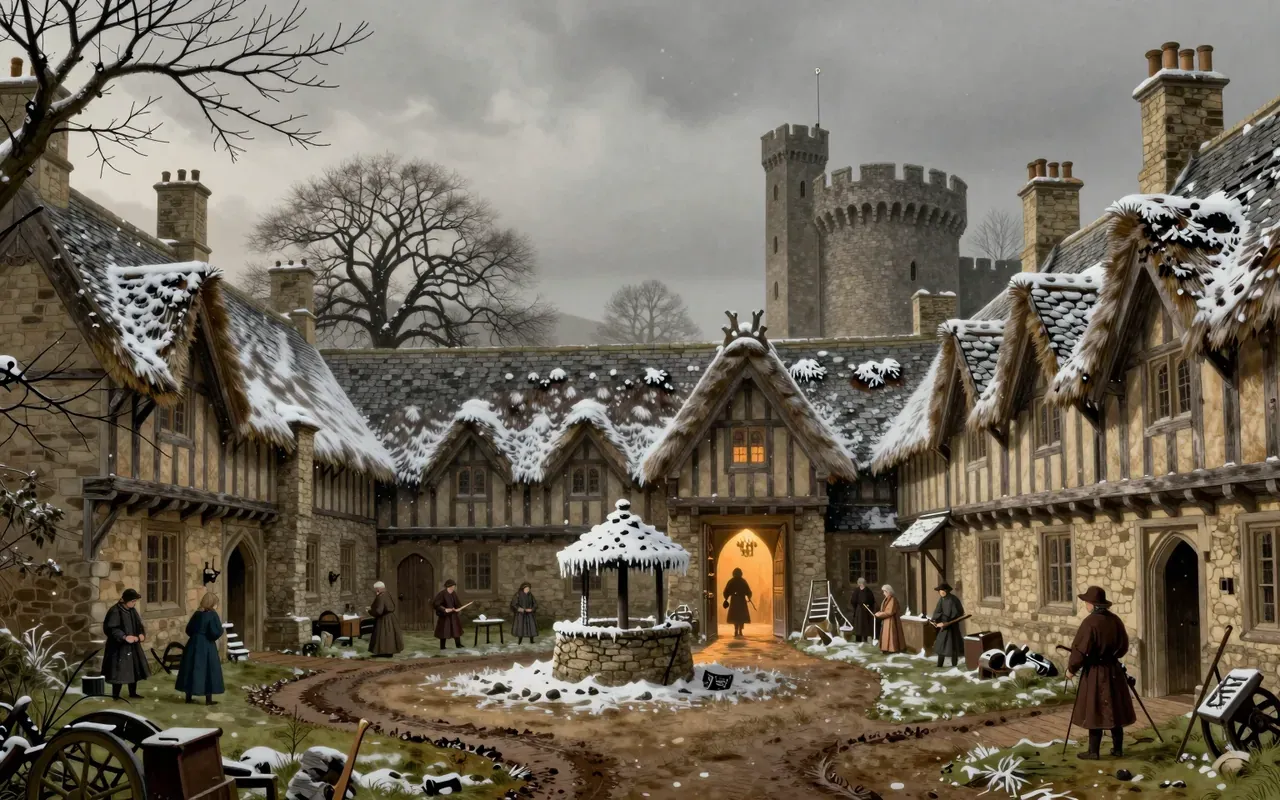
Weston’s 1922 prose version argues Gawain’s flaw is love of life—not lust or cowardice—and that the poem presents chivalry as covenantal, not performative. It clarifies the pentangle’s logic and the girdle’s meaning but sacrifices the poem’s alliterative force. Skip the Preface’s polemics.
The Green Knight is not a monster but a covenant-enforcer: his greenness signals nature’s indifference to human pride.
3:03
The pentangle's architecture
The pentangle is not decoration—it is Gawain’s moral operating system, binding senses, fingers, faith, and chivalry into one loop.
4:58
Hunting and seduction
Each day’s hunt mirrors each morning’s temptation: deer (evasion), boar (resistance), fox (deception). The girdle breaks the pattern.
7:38
The green girdle's meaning
Gawain’s single lapse—hiding the girdle—is forgiven because it springs from love of life, not disloyalty or pride.
10:26
What to skip
Skip the Preface’s attacks on Malory and Tennyson. They distract from the poem’s own logic.
Worth your time?
Selectively. Start with the brief, then read the parts we point at.
3.5/ 5
What works
The three-day covenant structure—hunting mirrored by temptation—is made legible and persuasive.
Weston’s reading of the girdle as protection against death, not sin, aligns with the Green Knight’s final judgment.
Her insistence on Gawain’s humility over heroism keeps the focus on accountability, not spectacle.
What does not
It flattens the poem’s alliterative verse into plain prose, losing the bob-and-wheel’s irony and the rhythm’s moral tension.
Weston’s dismissal of Malory and Tennyson adds no insight into the Cotton Nero text.
Her claim that Gawain is ‘faultless in his five senses’ contradicts the girdle episode’s deliberate ambiguity.
Read it if
Students needing a clear map of the poem’s covenant structure before tackling the original verse.
Readers focused on chivalric ethics, not poetic form or theological nuance.
Skip it if
Anyone studying Middle English alliterative metre or the bob-and-wheel’s function.
Readers who need the girdle’s symbolism left unresolved—as the original does.
The written brief2 min read
What the book is
A 1922 prose retelling by Jessie L. Weston, based on the Cotton Nero A.X. manuscript. It presents Sir Gawain and the Green Knight as the authentic, pre-Malory model of English chivalry—rooted in covenant, humility, and moral accountability.
The main ideas
Chivalry is covenantal, not performative. The Green Knight tests Gawain’s fidelity to three overlapping vows: to Arthur, to Bernlak, and to God. The girdle breaks only the second vow—but that fracture exposes how chivalric honour depends on total honesty, not selective courage.
What works
Weston clarifies the covenant logic across the three days: each hunt mirrors each temptation, each exchange of gains binds Gawain tighter. Her reading of the girdle as a test of love-of-life, not lust, is grounded in the Green Knight’s final judgment.
What does not
The prose translation sacrifices the poem’s sonic architecture: no alliteration, no bob-and-wheel, no rhythmic tension between line and clause. Weston’s insistence on Gawain’s purity ignores how the pentangle’s ‘endless knot’ mirrors the moral recursion in the girdle episode.
The themes
The poem turns on reciprocity: hunting and seduction, gift and blow, sin and absolution, shame and communal reintegration. Morgan le Fay’s plot reveals chivalry as a social technology—not innate virtue, but a system tested under pressure.
Who should read it
Readers who want a clear, argument-driven entry into the poem’s ethical architecture—not its poetic form. Those studying medieval chivalric codes or the Gawain tradition before Malory.
Who should not
Readers seeking the original verse’s alliterative force or its theological ambiguity. Anyone who needs the bob-and-wheel’s ironic punctuation or the green girdle’s unresolved symbolism.
The assessment
Weston treats the poem as a pre-monkish chivalric ideal, not a psychological study. She insists Gawain’s flaw is love of life, not lust or cowardice. Her prose rendering flattens the alliterative verse but makes the covenant structure legible. She dismisses Malory and Tennyson as distortions, not developments.
Is it worth your time
Selectively. Read chapters II–IV for the covenant structure and Gawain’s confession. Skip the Preface’s polemics against Malory and Tennyson—they add nothing to the poem’s internal logic.
Up next in Books
The Song of Hiawatha
Henry Wadsworth Longfellow · 11:50
A beautiful, hollow vessel: Longfellow’s Hiawatha sings Ojibway stories in Finnish metre while erasing their grammar, gods and land-rights.