What the book is
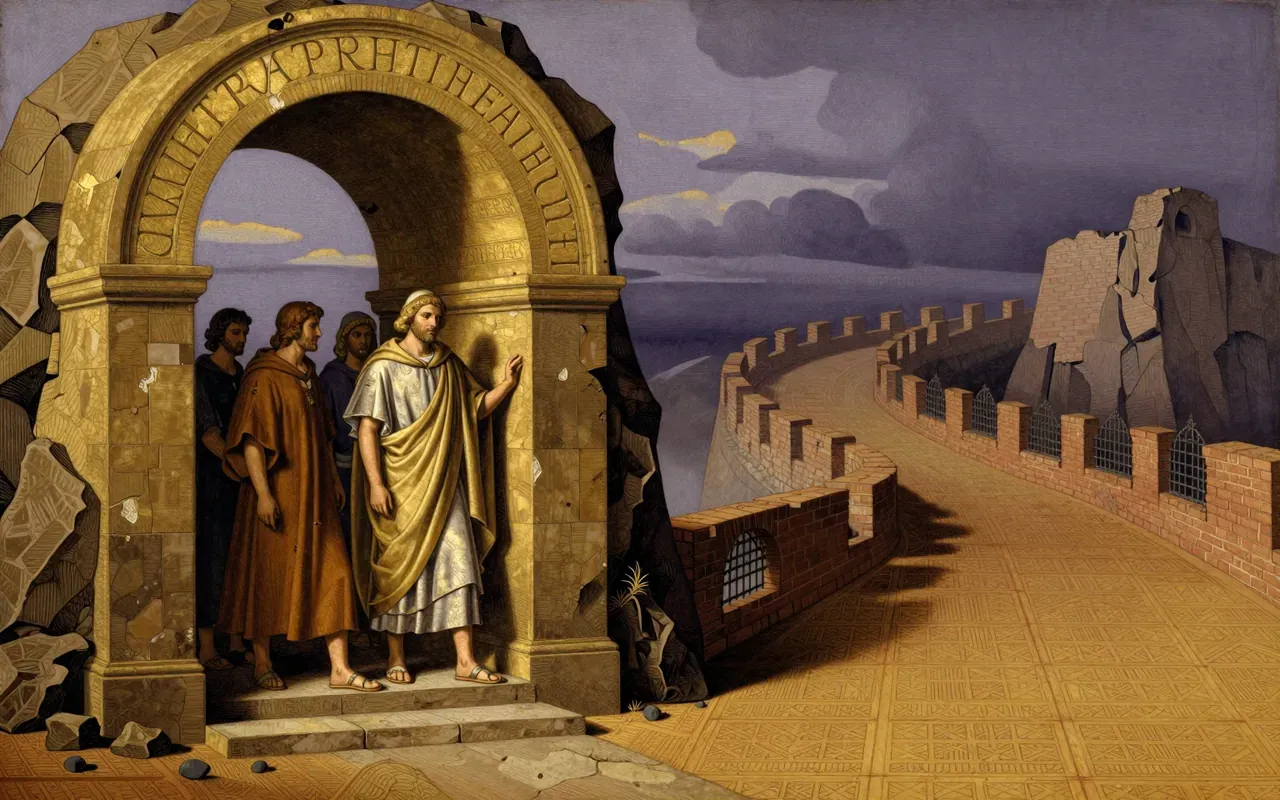
A 1321 Italian poem in terza rima, structured as a journey from Hell’s gate to the vision of the Trinity. Dante the pilgrim travels with Virgil through Hell and Purgatory, then with Beatrice through Heaven, ending with Bernard of Clairvaux guiding his gaze to Mary and Christ. It is allegorical, theological, and deeply political — naming real Florentines in every circle.
The main ideas
Hell is a geometric prison of frozen wills. Purgatory is a mountain where sin is unlearned through embodied correction. Heaven is a luminous rose where distance collapses under God’s presence. Each realm enacts a different logic of justice: retributive, corrective, and participatory. The poem insists that love — not law, not merit, not reason — is the force that orders creation and binds soul to God.
What works
The concentric circles of Hell give sin a spatial logic no other work matches. The mountain of Purgatory makes repentance physical and progressive. The rose of Heaven renders divine love as geometry and light — Q16 names it exactly. The shift from Virgil to Beatrice to Bernard maps a precise spiritual progression: reason → revelation → contemplation. The poem’s terza rima binds idea to form: each stanza’s third line resolves the tension of the first two.
What does not
It repeats its core mechanics across all three realms: guide departs, new guide arrives; sin punished by mirror-image suffering; vision limited then expanded. It assumes medieval theology as self-evident fact — no argument for why pride must be punished on the first terrace, or why fraud outranks violence in Hell’s ninth circle. It offers no psychological interiority: Dante the pilgrim never doubts his own worthiness, never questions Virgil’s authority, never resists grace.
The themes
The poem’s central theme is the alignment of will with divine love. It treats grace as non-negotiable and unequal: infants saved only through others’ merit, pagans damned despite virtue, Mary’s intercession required for final vision. It treats time as hierarchical: history unfolds in salvific eras, each tier of the rose marked by era and grace, not moral achievement. It treats knowledge as embodied: Dante must descend, climb, and ascend to see — no intellect alone suffices.
Who should read it
Readers who want to understand how medieval theology imagined cosmic order. Readers who need a concrete map of sin, repentance, and beatitude — not abstract ethics but bodies in specific places: lustful souls whirled in wind, proud souls bent under stone, the blessed arranged like petals in a rose. Readers who accept that form is argument here: terza rima’s interlocking lines mirror divine unity.
Who should not
Readers who expect psychological realism or narrative suspense. Readers who reject pre-modern cosmology as literal framework. Readers who find repeated invocations of Mary, Beatrice, and Bernard tedious rather than structural. Readers unwilling to accept that the poem’s power lies in its rigid architecture, not its character development.
The assessment
The Divine Comedy argues that divine justice is perfectly ordered, visible in Hell’s frozen logic, Purgatory’s proportional pain, and Heaven’s rose-shaped hierarchy. It fails when it insists salvation depends on baptism or Christian revelation — a claim Dante makes explicitly about unbaptised infants and virtuous pagans. The book’s structure forces repetition: Virgil vanishes at the same moment Beatrice appears; Bernard replaces Beatrice at the same threshold; the Trinity appears only after three intercessions.
Is it worth your time
Yes — if you read it as a system of thought made visible. No — if you read it as a story. Its value is architectural, not dramatic. You gain most by reading Canto XXXIV (Lucifer), Canto XXX (the river of light), Canto XXXI (the rose), and Canto XXXIII (the Trinity) — the four structural keystones. Skip the long theological digressions in Canto XXIX (angels) unless you are studying scholastic debate.