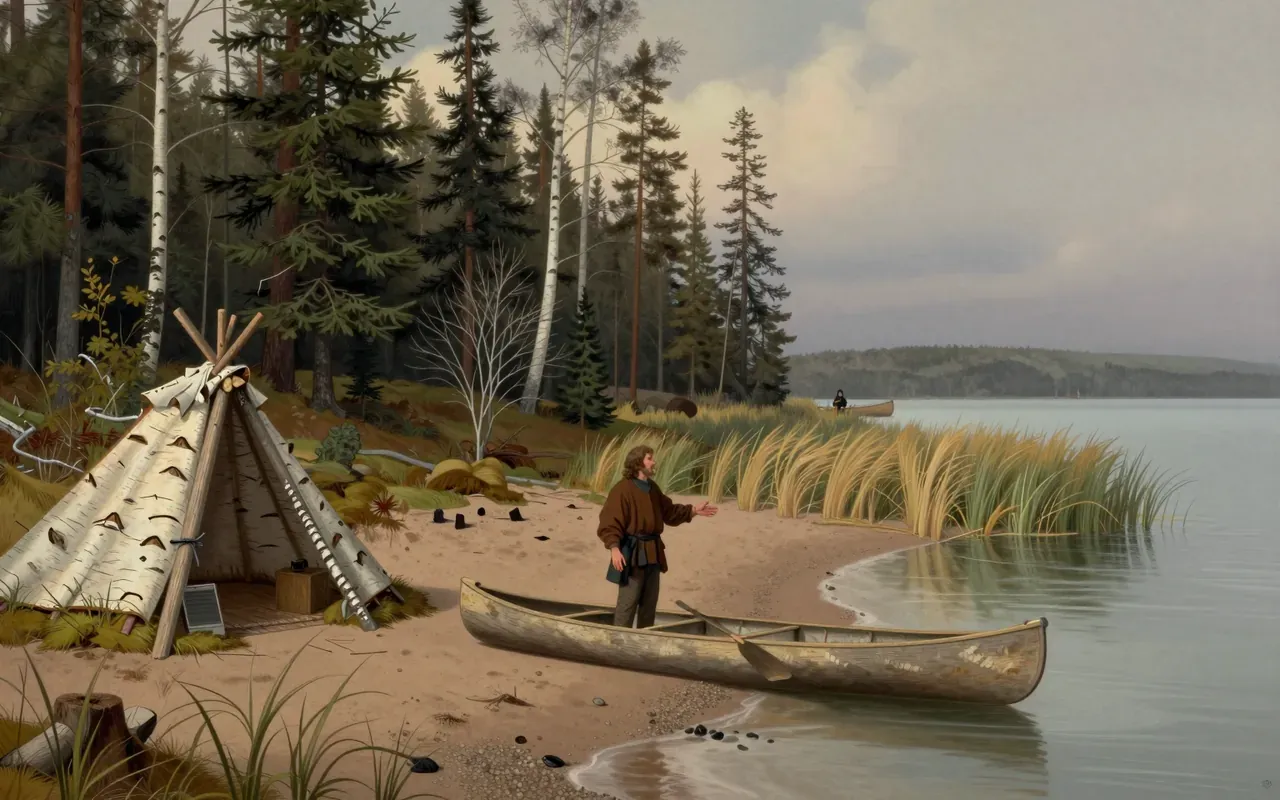
What the book is
A 1855 narrative poem in trochaic tetrameter, composed by Henry Wadsworth Longfellow, drawing on Ojibway oral traditions recorded by Henry Rowe Schoolcraft and Jane Johnston Schoolcraft. It tells the life of a mythic Anishinaabe hero named Hiawatha—from childhood under Nokomis, through trials including the killing of Pau-Puk-Keewis and the death of Minnehaha, to his final departure westward after encountering Christian missionaries.
The main ideas
Hiawatha embodies order, patience and ritual correctness against chaos (Pau-Puk-Keewis), envy (the Puk-Wudjies), grief (the ghosts), famine (Famine and Fever), and cultural rupture (the White Man’s Foot). His authority rests on hospitality, justice and prophecy—not conquest or lineage. His final departure is not defeat but fulfilment: he sails west alone after welcoming the Black-Robe chief, his canoe vanishing as nature laments.
What works
The rhythmic drive of the trochaic line makes key scenes unforgettable: Pau-Puk-Keewis strangled and hung ‘by the neck’ from the ridge-pole; Kwasind overwhelmed by Nepahwin ‘like a burnished Dush-kwo-ne-she’; Hiawatha standing ‘by the shore of Gitche Gumee’ at dawn before departure. The repetition of ‘By the…’ openings anchors the poem in place. Its ceremonial gravity—especially in the ghosts’ visit and the farewell in Chapter XXII—lands with quiet force.
What does not
It fails as ethnography: characters like Pau-Puk-Keewis and Kwasind are flattened into archetypes; their cultural specificity is subsumed by Longfellow’s moral schema. The poem omits Ojibway cosmology’s complexity—no mention of Nanabozho, no detail of clan systems, no reckoning with colonial violence beyond allegory. Its meter, borrowed from the Kalevala, imposes a European rhythm on Indigenous speech patterns, making the verse singable but alienating.
The themes
The poem treats hospitality as sacred law, tested by ghosts and famine. It frames transformation as both power and hubris—Pau-Puk-Keewis swells until he cannot pass through a doorway. It insists mourning must be ritualised, not indulgent: the ghosts warn that grave offerings burden the dead. And it presents cultural transition as inevitable, ordained, and non-negotiable: Peboan melts to make way for Segwun; Hiawatha departs as the Black-Robe chief arrives.
Who should read it
Readers interested in 19th-century poetic form, the history of literary appropriation, or how Indigenous stories were refracted through Romanticism should read it. Those studying the Kalevala’s influence on English verse will find its meter instructive. Anyone tracing the genealogy of American mythmaking—from Schoolcraft to Longfellow to modern Indigenous writers—must confront this text.
Who should not
Readers seeking authentic Ojibway theology or narrative should not read it. It contains no direct quotation from oral tradition, no citation of specific storytellers, and no engagement with Anishinaabe language structure. It is not a translation, nor a collaboration: it is a re-creation by an outsider using mediated sources.
The assessment
The Song of Hiawatha is a narrative poem in trochaic tetrameter, published in 1855, that recasts Ojibway oral traditions—collected by Henry Rowe Schoolcraft and Jane Johnston Schoolcraft—into a unified mythic biography of Hiawatha. It does not retell the historical Iroquois diplomat Hiawatha but constructs a new, pan-Indigenous hero from Anishinaabe sources. The poem’s structure follows a sequence of episodic trials: Pau-Puk-Keewis’s sacrilege in Chapter I, Kwasind’s death in Chapter III, the ghosts’ test in Chapter IV, Minnehaha’s death in Chapter V, and Hiawatha’s departure after the Black-Robe chief arrives in Chapter XXII.
Is it worth your time
Selectively. Read Chapters I, IV, V and XXII—the core moral and structural pivots—and skip the botanical interludes and digressive hunting lore. The poem’s power lies in its cadence and its stark moral architecture, not its ethnographic fidelity or psychological depth.