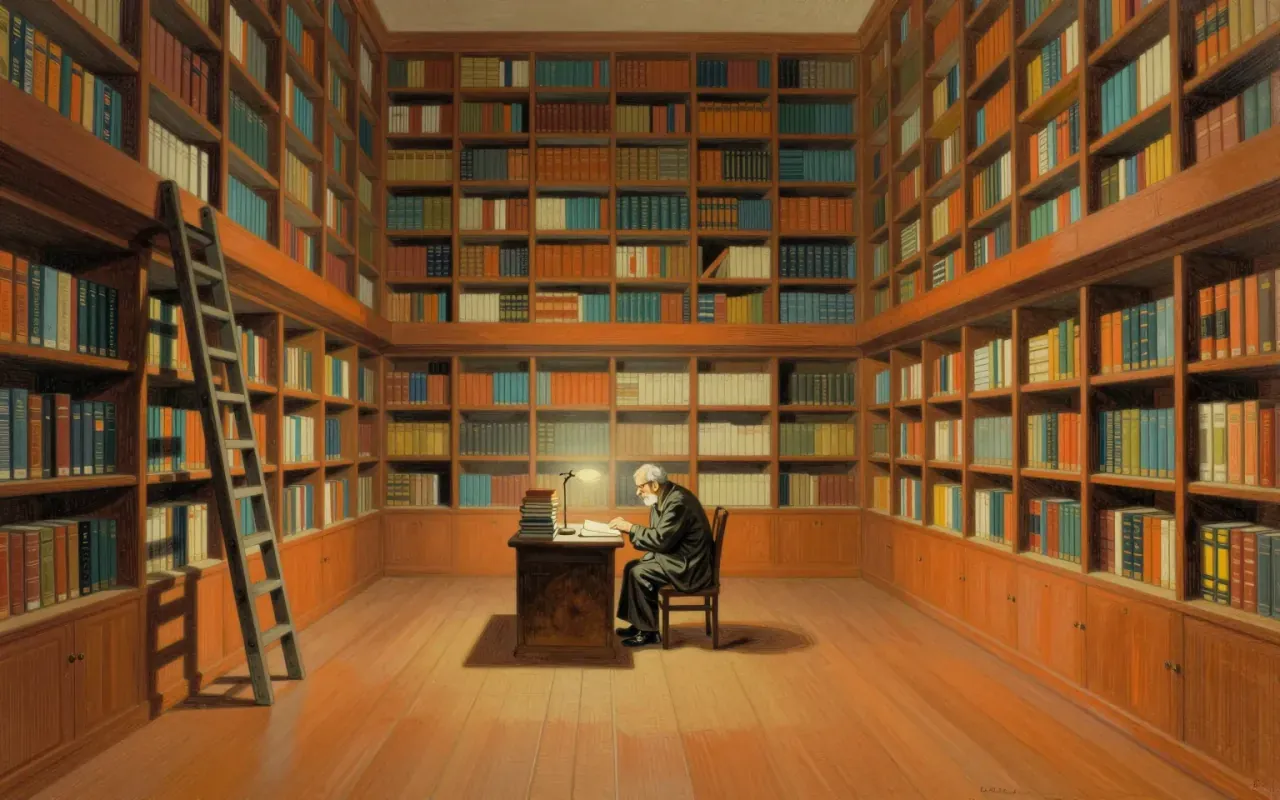
A galactic empire falls in three centuries. One man saw it coming and built a library to survive it.
A math professor and three hundred thousand people are sent to the edge of the galaxy to establish a Foundation that preserves human knowledge. The book follows four crises that test whether mathematical prediction can outmaneuver political chaos and interstellar war. It is the story of how institutions outlast empires.
Psychohistory: a science that predicts the behavior of galactic empires the way physics predicts billiard balls. Seldon uses it to see four hundred years into humanity's future.
2:00
The Foundation
A hundred thousand scientists and scholars are sent to a remote planet as a decoy to the empire. Their secret mission: preserve all human knowledge while the empire collapses.
4:45
Crisis one
Religion, science, and power collide. When the Four Kingdoms surround the Foundation, Seldon's mathematics says survive through the priesthood.
8:00
What endures
The book asks what institutions can predict and what they cannot. Violence, greed, and desire for power cannot be deleted from human behavior, only channeled.
Worth your time?
Yes. Read the whole thing.
4.5/ 5
What works
The central idea—that mathematics can guide civilization—is original and thought-provoking
Each crisis is a distinct political problem, not a repeat
It was written in an age when science fiction was pulp; its ideas were ahead of that medium
What does not
Characters are thin; they exist to carry ideas rather than be interesting people
The science is dated, though the math remains sound
Later books in the series attempt to reconcile this with Foundation's Edge and further extensions
Read it if
Anyone who wants to see where modern science fiction came from
Readers interested in mathematics applied to society and history
Skip it if
Readers expecting a narrative; this is a series of political situations
The written brief1 min read
What the book is
Asimov’s 1951 collection of five connected short stories, originally published 1942–1950. A mathematician develops psychohistory, a mathematics of predicting galactic history, and uses it to preserve human knowledge through a coming dark age.
Is it worth your time
Yes. It is the foundational text of modern science fiction, written before the field knew what it was. Read it for the ideas, not for the prose or the people.