An old fisherman's three-day battle with a marlin becomes Hemingway's argument about endurance in the face of inevitable loss.
Santiago, an aging Cuban fisherman who hasn't caught anything in 84 days, hooks a giant marlin and fights it for three days. When he finally lands it, sharks strip his prize to a skeleton. Hemingway's spare prose turns the ordeal into a study of human will against indifference.
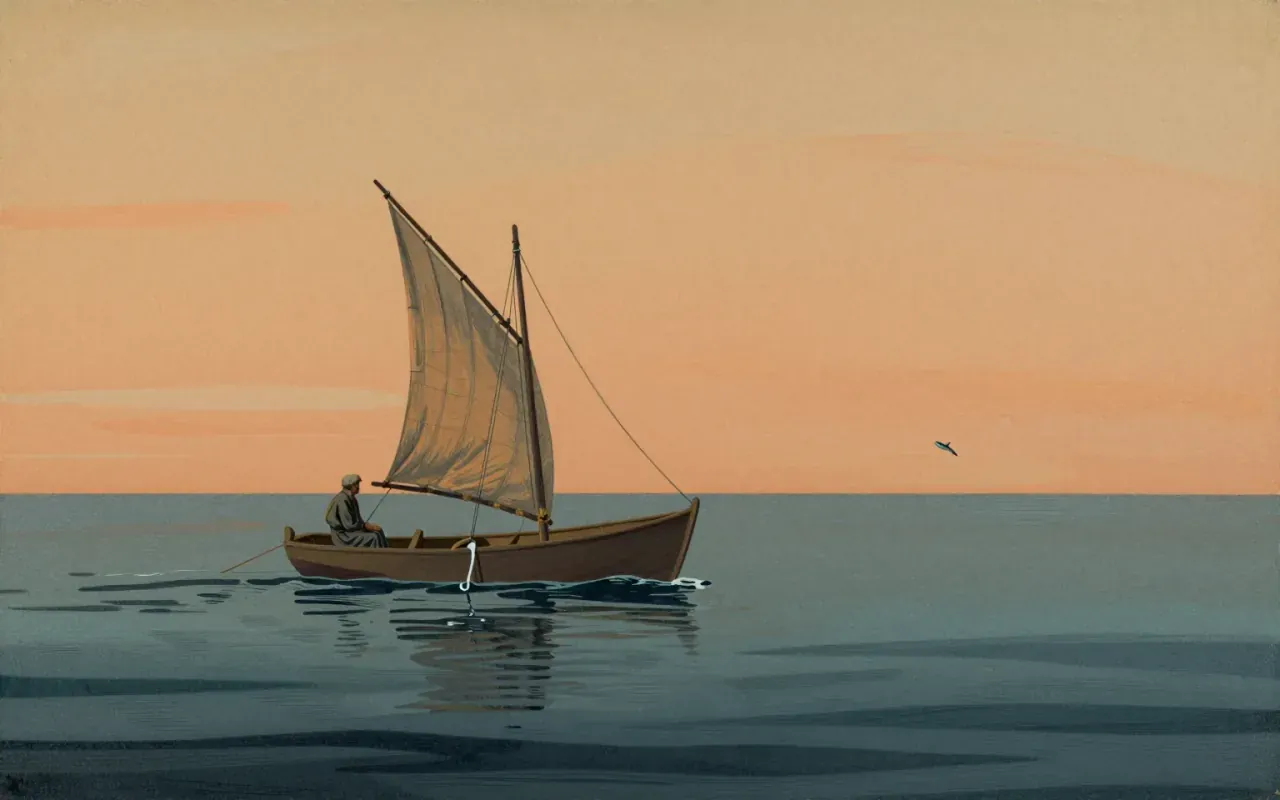
Santiago, 84 days without a catch, is both respected and pitied. He has skill and pride, but no luck.
2:30
The strike
A fish so big he cannot see it breaks his line. He hooks something that changes everything.
5:00
The battle
Three days of pure contest. The fish will not die, and neither will Santiago give up.
7:30
The sharks
Victory turns to loss. What he fought so hard to catch becomes carrion eaten by scavengers.
Worth your time?
Selectively. Start with the brief, then read the parts we point at.
4/ 5
What works
The prose is relentless and precise; not a word wasted
The central contest is genuinely gripping across all three days
Works simultaneously as literal adventure and philosophical allegory
Can be read in one sitting
What does not
The mysticism and repetition frustrate some readers
The gender politics are of their time and reveal limitations
The ending's ambiguity disappointed those expecting triumph
Feels thin or melodramatic to readers unacquainted with Hemingway's style
Read it if
Readers willing to sit with stillness and sparse prose
Anyone interested in how suffering is endured, not escaped
Those who appreciate economy of language
Skip it if
Readers who need constant plot movement
Anyone looking for romantic love or complex relationships
Those who dislike ambiguous endings
The written brief1 min read
What the book is
Hemingway’s 1952 novella. An aging Cuban fisherman, Santiago, sets out alone and hooks a marlin so large and strong that it tows his small boat for three days. After finally landing it, he must fight sharks to bring his prize back to shore.
Is it worth your time
Selectively. It is genuinely gripping and can be finished in an afternoon. But Hemingway’s minimalism and the work’s heavy symbolic weight don’t land the same way they did in 1952, and readers expecting conventional triumph will be disappointed by what the book leaves you with.