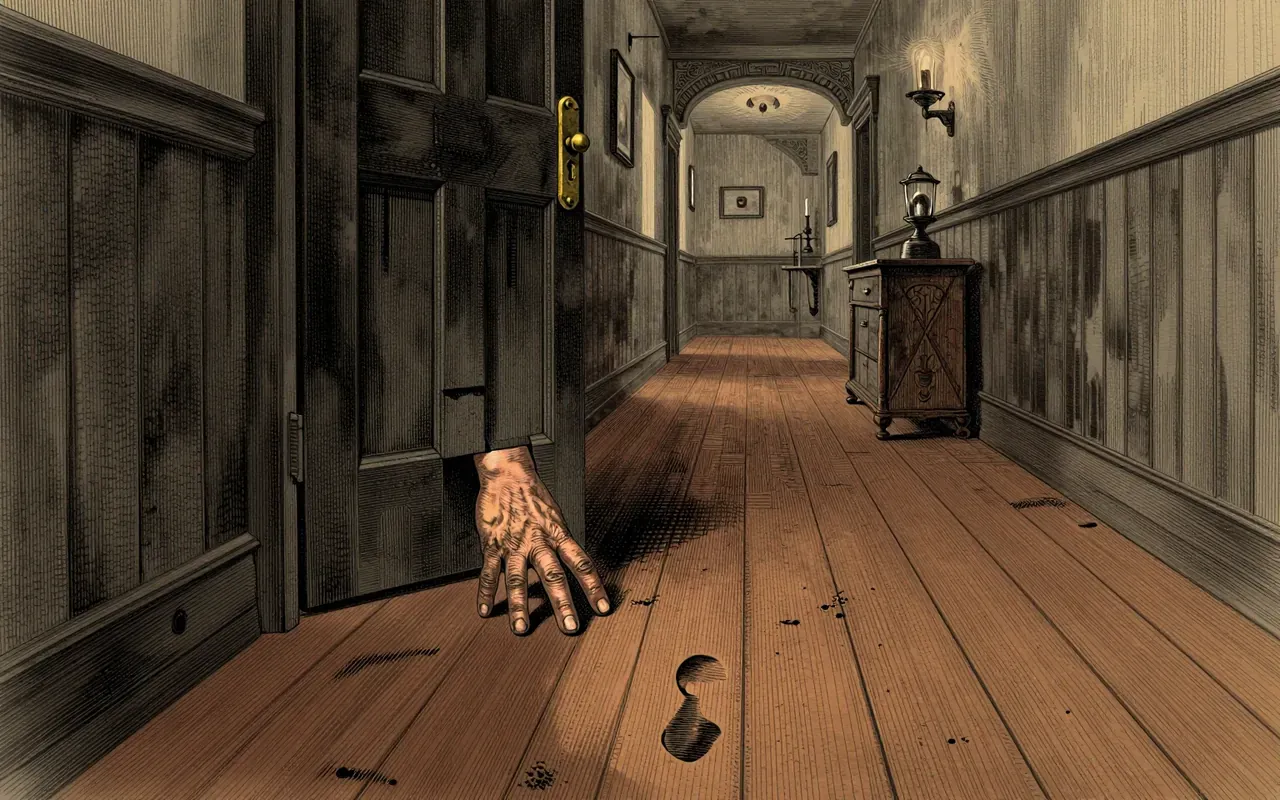
What the book is
A Victorian Gothic novella published in 1886, structured as three nested testimonies: Utterson’s investigation, Lanyon’s eyewitness account, and Jekyll’s final confession. It centres on a chemist who drinks a potion to isolate his evil self — and becomes trapped as Hyde.
The main ideas
Human nature is irreducibly dual. Scientific ambition must be bound by moral restraint. Externalising evil does not free the good; it entangles both selves fatally. The self cannot be split without destroying both parts.
What works
The three-testimony structure creates mounting inevitability. Jekyll’s confession delivers visceral dread through plain language and escalating physical decay. The absence of explanation for the potion forces attention onto consequence, not mechanism. Hyde’s small stature and unsettling gait make him physically legible as corruption.
What does not
It fails to explore Victorian medicine or chemistry in any detail. There are no descriptions of apparatus, reagents, or procedures. The potion is a narrative device, not a scientific proposition. The story avoids explaining how the transformation works — and gains power from that silence.
The themes
The book turns on duality, scientific hubris, moral accountability, and the impossibility of excising evil without erasing the self. It treats Hyde not as a separate being but as the unmediated expression of Jekyll’s will — a claim made explicit in Jekyll’s confession.
Who should read it
Readers who want a tightly wound psychological fable about moral accountability. Those studying how literature encodes Victorian anxieties about science, class, and repression. Anyone who needs proof that brevity can carry philosophical weight.
Who should not
Readers expecting forensic realism about chemistry or physiology. Those seeking social critique of London life beyond the fog-shrouded streets and locked doors. Anyone who requires character backstories, romantic subplots or worldbuilding beyond the immediate moral architecture.
The assessment
The book argues that human nature is fundamentally dual and that scientific ambition without moral restraint leads to self-destruction. It shows Jekyll’s experiment failing not because of a lab error, but because splitting the self violates an immutable law. The collapse is inevitable: Hyde grows stronger while Jekyll weakens, until the final confession confirms no return is possible.
Is it worth your time
Yes — if you read it straight through in one sitting. Its power depends on compression and pacing. It loses force when parsed slowly or treated as allegory first. At 60 pages, it earns its place not as a period curiosity but as a working model of moral psychology.