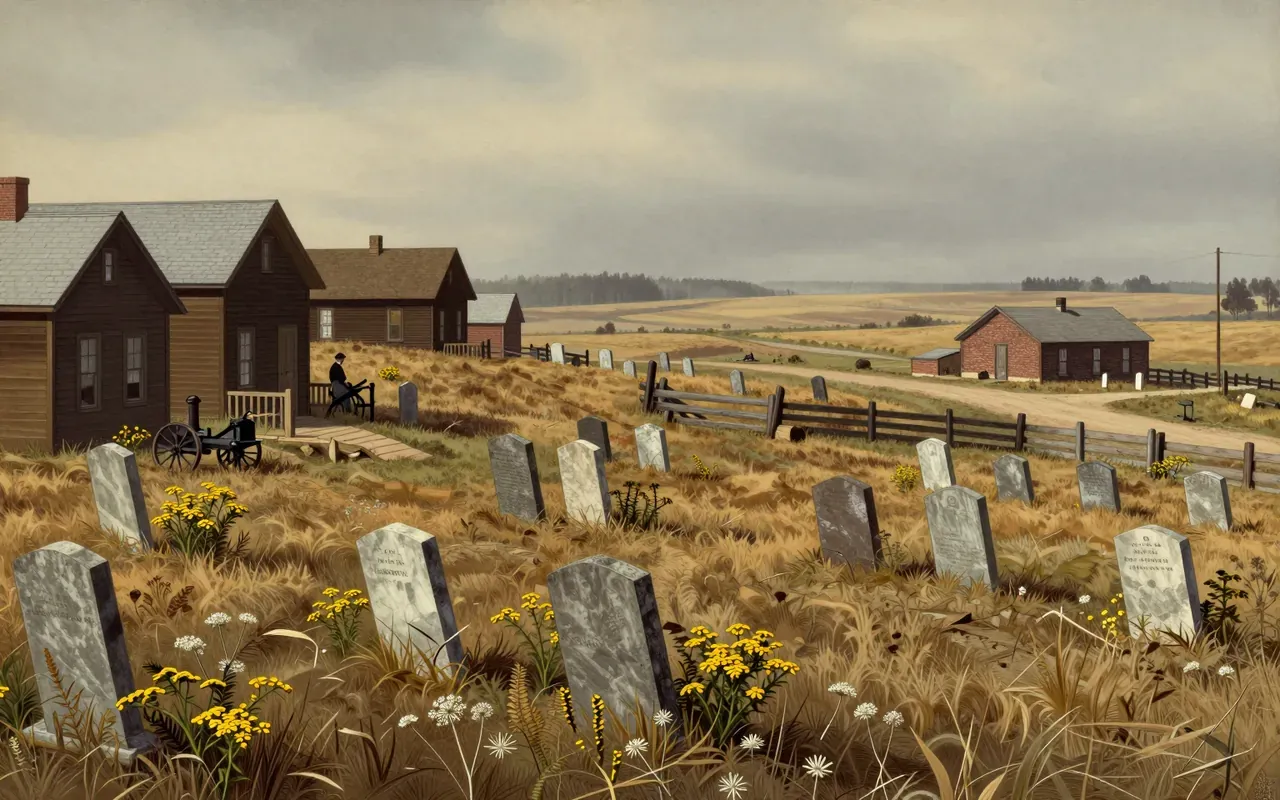
What the book is
A sequence of over 200 first-person epitaphs spoken by the dead of Spoon River. No narrator. No plot. Only names—Cabanis, Flossie; Dippold the Optician; Elmer, Herman, Bert, Tom and Charley—and their posthumous confessions. The Hill is the entire book’s substance. The Epilogue is an appended cosmological coda.
The main ideas
Each epitaph in The Hill rewrites a life after death—Cabanis, Flossie; Dippold the Optician; Elmer, Herman, Bert, Tom and Charley—exposing how reputation masks reality. The dead speak plainly, without apology or ornament. The Epilogue rejects this method: Beelzebub declares human character predetermined by ‘dust’, ‘slime’, ‘rust’ and ‘lime’ (Q7), then reduces mind to a ‘Jack-o’-lantern’ (Q8).
What works
The Hill delivers what it promises: direct, unsentimental speech from the dead. Each name carries weight—‘Cabanis, Flossie’ (Q1), ‘Dippold the Optician’ (Q2), ‘Elmer, Herman, Bert, Tom and Charley’ (Q3). The lines ‘She took my strength by minutes’ (Q4) and ‘Where are Elmer, Herman, Bert, Tom and Charley’ (Q3) show how economy and rhythm build emotional force.
What does not
The Epilogue abandons the dead’s voices for mythic spectacle. Beelzebub, Loki and Yogarindra do not appear in The Hill. Their clay-and-slime creation scene (Q7) and Jack-o’-lantern mind (Q8) contradict the book’s central premise: truth emerges only from lived experience, not divine explanation.
The themes
Mortality is the lens. Hypocrisy is the pattern. Determinism is the argument. Place—Spoon River—is the anchor. Every theme is rooted in a named speaker or quoted line: ‘She took my strength by minutes’ (Q4), ‘Where are Elmer, Herman, Bert, Tom and Charley’ (Q3), ‘Out of the dust, out of the slime’ (Q7).
Who should read it
Readers who value concision, American vernacular, and the moral clarity of the grave. Those who recognise ‘Cabanis, Flossie’ (Q1) or ‘Dippold the Optician’ (Q2) as real presences—not types—will find the book indispensable.
Who should not
Readers who require sustained narrative, psychological development, or thematic consistency across sections. The Epilogue’s Beelzebub and Loki have no precedent in The Hill and break the book’s pact with the reader.
The assessment
The book argues that death strips away social pretence and reveals the deterministic forces—heredity, trauma, class—that shape lives in Spoon River. It fails when the epilogue abandons its own dead for cosmic allegory. The Hill section works because each voice is distinct, unsentimental, and grounded in a specific life: Cabanis, Flossie; Dippold the Optician; Elmer, Herman, Bert, Tom and Charley. What does not work is the Epilogue’s shift to Beelzebub and Loki, which contradicts the anthology’s core method: truth spoken by the dead, not staged by gods. Themes are mortality, hypocrisy, determinism, and the weight of place. Readers who want unvarnished American realism should read it. Those who need narrative continuity or psychological exposition should not. It is worth your time only if you accept poetry as testimony.
Is it worth your time
Yes—if you read only The Hill. Skip the Epilogue. Its ‘dust’, ‘slime’, ‘rust’ (Q7) and ‘Jack-o’-lantern’ (Q8) are conceptually at odds with the epitaphs’ grounded truth-telling. The Hill alone is 95% of the book’s value.