What the book is
A historical novel set in Spanish-ruled Lombardy in 1628–30. It follows Renzo and Lucy’s thwarted marriage, Gertrude’s forced vows, Don Abbondio’s cowardice, and the Unknown’s conversion—culminating in Milan’s plague and the couple’s eventual wedding in Bergamo.
The main ideas
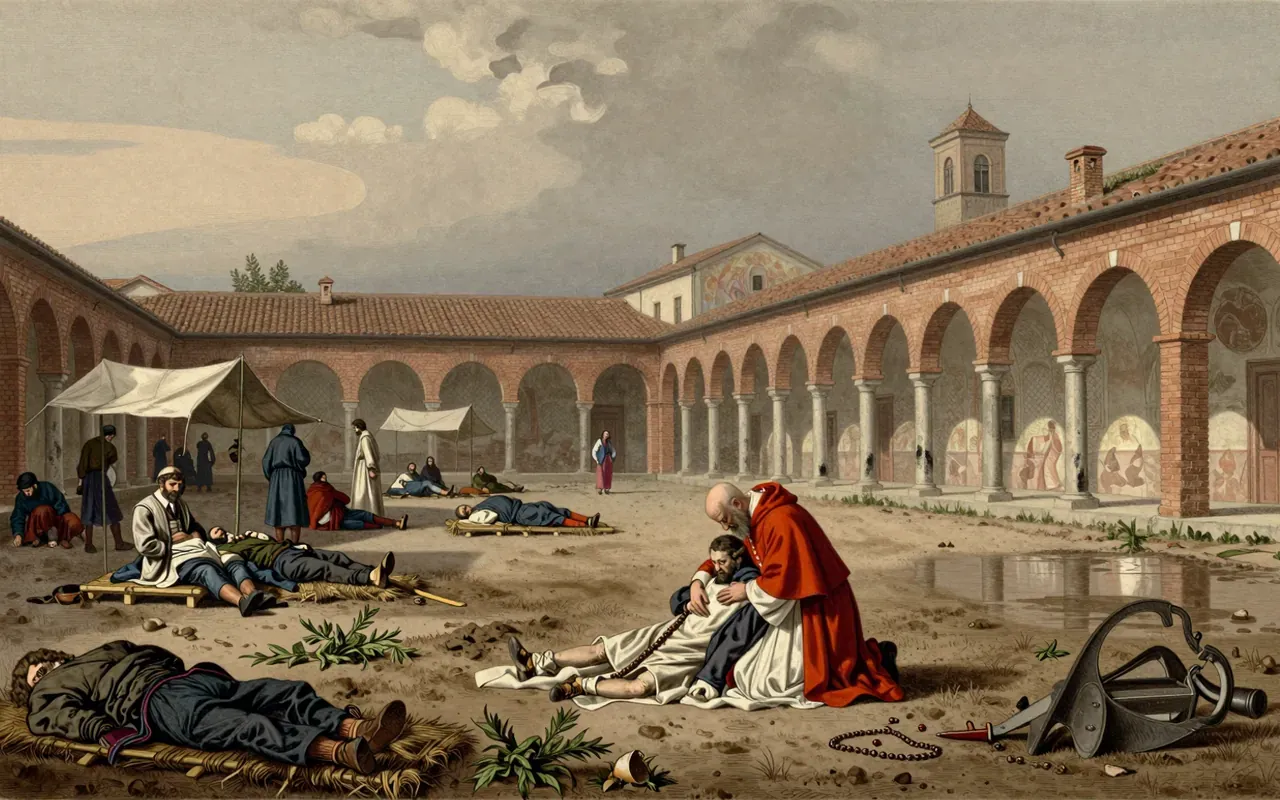
Power operates through impunity, not law. Consent is routinely coerced—by family, church, or state—then dressed as virtue. Moral courage is impossible without material security. Grace arrives not through doctrine but through embodied encounters: Lucy’s prayers, Borromeo’s embrace, rain washing plague from the streets.
What works
The Unknown’s conversion works because it hinges on Lucy’s silent suffering—not rhetoric. Don Abbondio’s cowardice is grounded in the line ‘The arm of the law afforded no protection’. The rain at the end works as both literal cleansing and theological punctuation: ‘This water carried off, washed away, so to speak, the contagion.’
What does not
It fails to resolve Gertrude’s arc with the same weight as Lucy’s or Renzo’s. Her coerced entry into the convent is analysed psychologically, but her later silence leaves her fate vague and her agency unexamined. The novel treats her as a case study in spiritual violence, not a subject of redemption.
The themes
The novel centres on the tension between institutional authority and personal conscience. It shows how bureaucracy turns people into legible subjects, how monastic life can mask psychological violence, and how catastrophe reveals virtue and folly in equal measure. Providence acts not through miracles but through ruined roads, abandoned houses, and the death of arrogant scholars.
Who should read it
Readers who want a theological novel where grace is physical, not abstract: where a cardinal’s handshake matters more than a sermon, and rain on a man’s face signals divine mercy. Those interested in how institutions coerce consent—through vows, signatures, or confessions—will find its machinery laid bare.
Who should not
Readers seeking psychological realism without doctrinal framing. Those who dislike providential plots where plague ‘sweeps off’ villains. Anyone unwilling to engage with Catholic sacramental logic—vows, absolution, penitence—as narrative engines.
The assessment
The book argues that moral transformation requires both divine grace and human vulnerability. Lucy’s suffering breaks the Unknown’s will. Cardinal Borromeo’s compassion—not doctrine—converts him. Don Ferrante’s syllogisms kill him while Renzo’s mud-caked joy survives. The plague is not punishment but a ‘serviceable broom’ that clears tyrants and makes space for marriage, faith, and ordinary happiness.
Is it worth your time
Yes—if you accept its premise that moral truth is revealed in extremis: in barricaded streets, in a friar’s cell, in a scholar’s fatal syllogism. Skip nothing. Its power lies in the accumulation: each chapter tightens the knot between power, fear, and grace.