What the book is
A three-act stage play set over three days in a middle-class Oslo flat in 1879. Nora Helmer lives under her husband Torvald’s supervision, concealing a loan she secured by forging her father’s signature to fund his recovery in Italy.
The main ideas
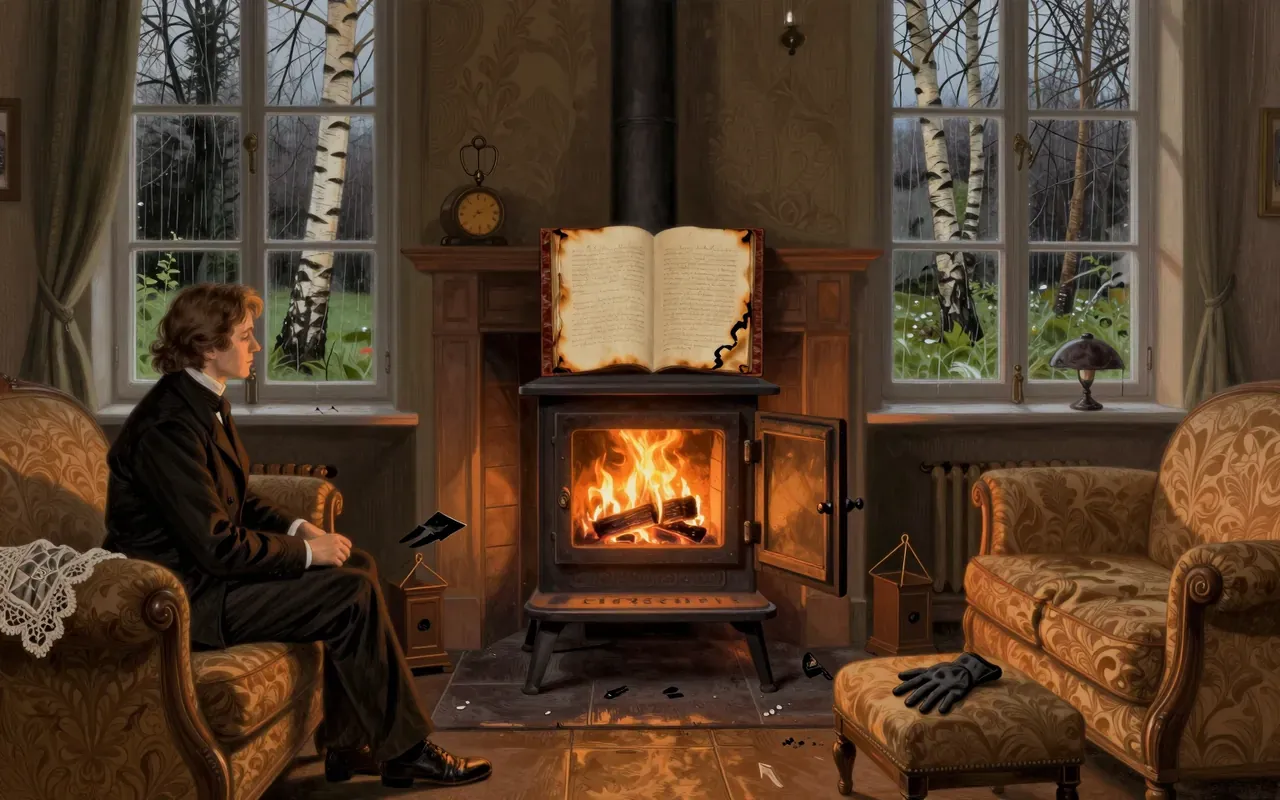
The play argues that bourgeois marriage enforces infantilisation through financial, legal and moral control. Nora’s forgery is both crime and act of love—and the law judges only the first. Helmer’s fury proves that his ‘love’ depends on her dependence. The Christmas tree’s gradual disarray mirrors the collapse of domestic theatre.
What works
The structure is relentless: each act tightens the vise. The Tarantella rehearsal is not colour but crisis—the dance’s frenzy externalises Nora’s internal fracture. The letter dropping into the mailbox is a silent, irreversible event. The door slam is the only sound that matters.
What does not
It fails to imagine life beyond the door slam. Nora names no destination, cites no mentor, sketches no plan. Her exit is absolute but unanchored. The play offers no model for self-education beyond rejection. It gives us the rupture but not the reconstruction.
The themes
The themes are gendered legality, performative domesticity, and conscience versus convention. Nora’s realisation—that she has never held a thought ‘of her own’—is not psychological but juridical: she has been legally voiceless inside her own home.
Who should read it
Readers who want to understand how legal personhood was withheld from married women in nineteenth-century Scandinavia. Anyone studying the genealogy of feminist critique in drama. Students of realism who need to see how form enacts ideology.
Who should not
Readers expecting narrative resolution or character development beyond Nora’s break. Those seeking historical context about Norway’s 1882 Married Women’s Property Act will find none—it is absent from the text.
The assessment
The assessment is that Nora’s departure is not a gesture but a verdict. Her final line—‘I must stand quite alone’—is the book’s thesis, not its climax. Ibsen dismantles the marriage contract as a legal fiction that masks female dispossession. The forged bond is not a plot device; it is the structural analogue of every woman’s signature in a society that treats her as a minor.
Is it worth your time
Yes—if you read it as a legal document disguised as drama. Its power lies in what it refuses to show: no backstory for Krogstad, no grief for Nora’s father, no future for the children. It compresses an entire social order into thirty-one hours.