What the book is
A Russian novel published in 1862, centred on Bazarov—a medical student who declares all authority null—and his collision with two families: the liberal landowner Nikolai Petrovitch and his brother Pavel, and the aristocrat Anna Sergievna Odintsov. Its action unfolds across six country estates over a single summer.
The main ideas
Nihilism is embodied, not theorised: Bazarov lives it, then dies by it. Generational conflict is biological as much as ideological: Arkady’s return to Nikolsköe (Chapter XXI), Katia’s assessment of him as ‘tame’ (XXV), and Bazarov’s physical collapse (XXVII) all hinge on bodies, not manifestos. Parental love persists without reciprocity: Nikolai’s bathing-place for Fenichka (XXIII), his fumbled toast at Marino (XXVIII), and his lifelong care for Bazarov’s grave are acts stripped of reward.
What works
Bazarov is unforgettable because he is inconsistent: he dissects frogs yet trembles before Anna Sergievna (XXVI); he scorns sentiment yet demands his father’s presence in his final hours (XXVII); he names Arkady’s domestication a failure (XXVI) yet weeps silently when leaving Nikolsköe (XXI). The lilac arbour (XXIII) and the duel (XXIV) are perfect, compressed set-pieces where silence speaks louder than dialogue.
What does not
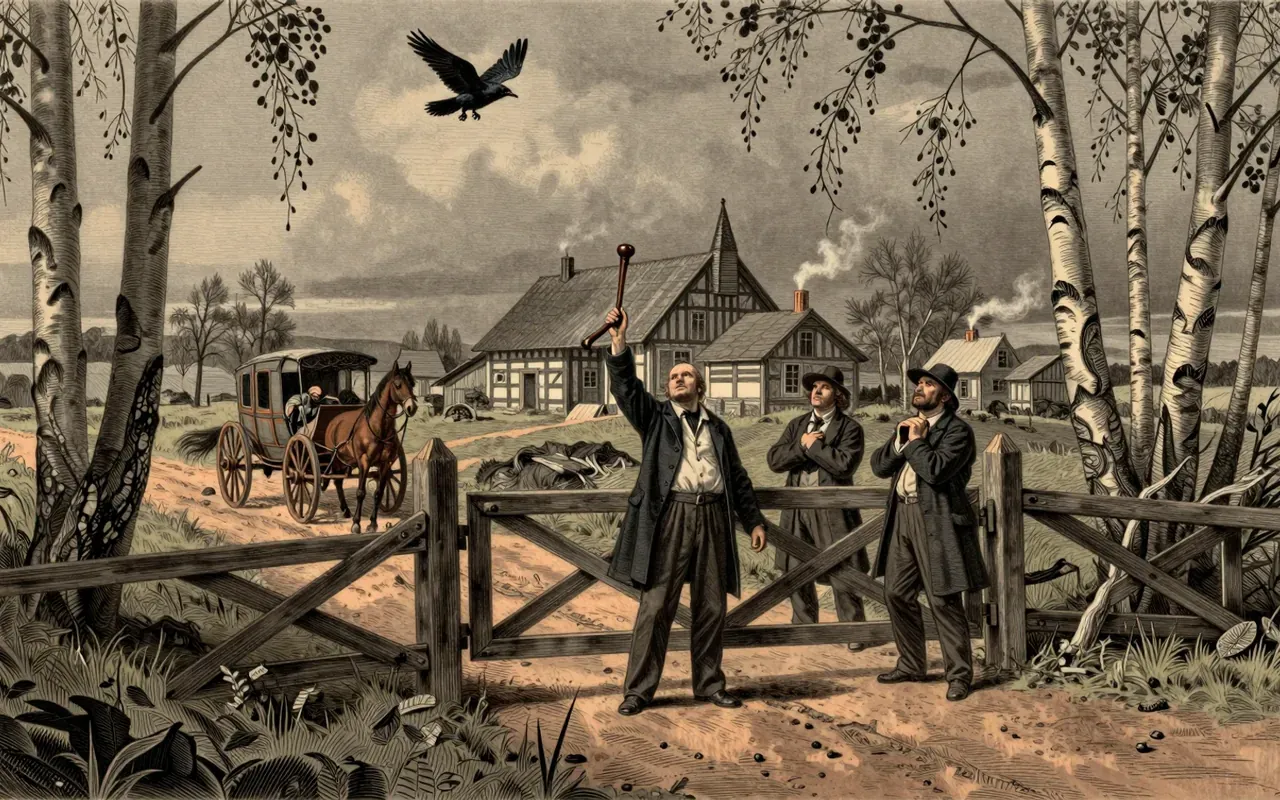
It fails to dramatise the political stakes of nihilism beyond personal rupture. No scene shows Bazarov debating policy, organising, or confronting state power. The duel with Pavel Petrovitch (Chapter XXIV) is psychological theatre, not ideological combat. The Slavophiles and liberals named in the Epilogue (XXVIII) appear only as footnotes to Bazarov’s absence.
The themes
The tension between intellectual kinship and erotic need (Anna Sergievna and Bazarov in XXVI), the absurdity of aristocratic ritual masquerading as principle (the duel in XXIV), and the quiet endurance of peasant pragmatism against nihilist abstraction (the unnamed peasant who treats Bazarov’s infection in XXVII).
Who should read it
Readers who want to see ideology tested in the body: Bazarov’s feverish confession to his father (XXVII), his kiss in the lilac arbour (XXIII), and Arkady’s tearful proposal in the ruined Greek temple (XXVI) are irreplaceable scenes of thought made flesh.
Who should not
Readers seeking historical context about the 1860s Russian intelligentsia will find none. No reference to the Emancipation Edict of 1861, no depiction of student circles in St Petersburg, no engagement with Chernyshevsky or Dobrolyubov—only what appears in the digest and quotes.
The assessment
The book argues that nihilism is a generational toxin that kills its host before it can reform society. Bazarov’s death from typhus—contracted while rejecting superstition and embracing empirical care—exposes the fatal gap between his doctrine and human frailty. His father’s silent, tender nursing in Chapter XXVII and the grave tended by both parents in Chapter XXVIII are the novel’s final, unarguable rebuttals.
Is it worth your time
Yes—if you read only Chapters XXI–XXVIII. Skip the Introduction (Chapter 0) entirely: its claims about history’s ‘terrible and irresistible’ validation (Q2) are unsupported by the text and contradict the novel’s own epilogue, where Kukshin and Sitnikov fade into irrelevance (XXVIII).