What the book is
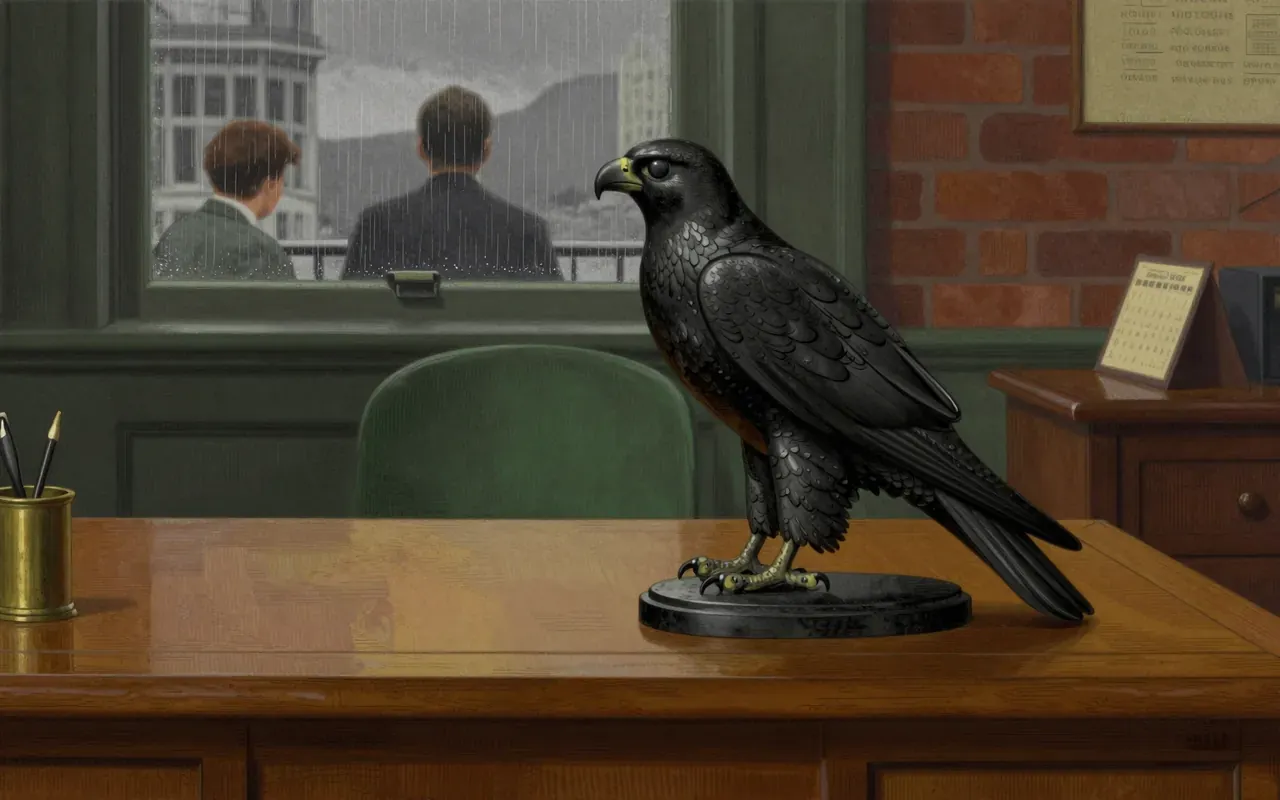
A 1930 hard-boiled detective novel set in San Francisco. Samuel Spade investigates the murder of his partner Miles Archer, uncovers a web of lies centred on Brigid O’Shaughnessy, and pursues a black statuette—the Maltese falcon—whose true nature is revealed in Part 2.
The main ideas
The book treats identity as costume: Brigid shifts names and stories like gloves. Spade’s code is procedural, not philosophical—he cites duty, not justice. The falcon is never described in detail until its exposure as worthless. Every major character fails to grasp that the object they kill for is inert, and that the real power lies in who controls the narrative.
What works
Spade’s voice is consistent and lethal: ‘He went like that,’ he says of Archer’s death (Q2), reducing tragedy to gesture. The falcon’s physical emptiness mirrors the hollowness of every claim made about it. Brigid’s kneeling plea (Q1) is the only moment of raw vulnerability—and it’s performative, immediately followed by negotiation.
What does not
It offers no psychological depth for Brigid beyond performance. Gutman’s monologue about the falcon’s history is exposition, not character. The San Francisco setting remains a backdrop, never shaping action or theme. There are no interior monologues, no moral ambiguity beyond Spade’s cold calculus.
The themes
The book insists truth is unstable, but only as a tool—not a subject of inquiry. Loyalty is contractual, not affective. Value is assigned, not inherent: the falcon gains and loses meaning based on who holds it and what they claim. Performance is survival: Brigid kneels (Q1), Spade smiles while lying, Cairo bows before a fake.
Who should read it
Readers who want a tightly wound plot where every line advances motive or misdirection. Fans of dialogue-driven noir who value precision over psychology. Anyone studying how genre fiction enforces moral economy through structure, not sermon.
Who should not
Readers seeking character interiority or social context. Those who require thematic expansion beyond the central conceit. Anyone put off by clipped syntax, withheld exposition, or a protagonist who never wavers, doubts or reflects.
The assessment
The Maltese Falcon argues that loyalty is a professional obligation, not an emotional one. Spade’s final act—handing Brigid to the police—is framed not as betrayal but as adherence to a code he names aloud: ‘When a man’s partner is killed he’s supposed to do something about it.’ The falcon’s revelation as a lead fake confirms the book’s thesis: all the violence, lies and desire orbit a hollow object. Nothing in the plot contradicts this. The book holds its line with surgical consistency.
Is it worth your time
Yes—if you read it as a machine built to test one idea: whether integrity can be procedural. It delivers that idea without deviation, repetition or apology. At under 200 pages, it wastes no time. Skip nothing; every scene tightens the coil.