What the book is
A five-act drama set entirely in the Ekdal apartment and loft in late-nineteenth-century Christiania. It follows three days after Gregers Werle returns home and inserts himself into the Ekdal household. No scene occurs outside the flat or its attic. The wild duck appears alive in Act II and dies offstage in Act V.
The main ideas
The wild duck embodies compromised survival: injured, domesticated, dependent on the loft’s false forest. Hjalmar’s ‘mission’ is performance masking dependency on Werle. Relling’s ‘life-lie’ is not deception but oxygen—the air ordinary people breathe to live. Truth is not neutral; it is a weapon wielded by the unburdened against the vulnerable.
What works
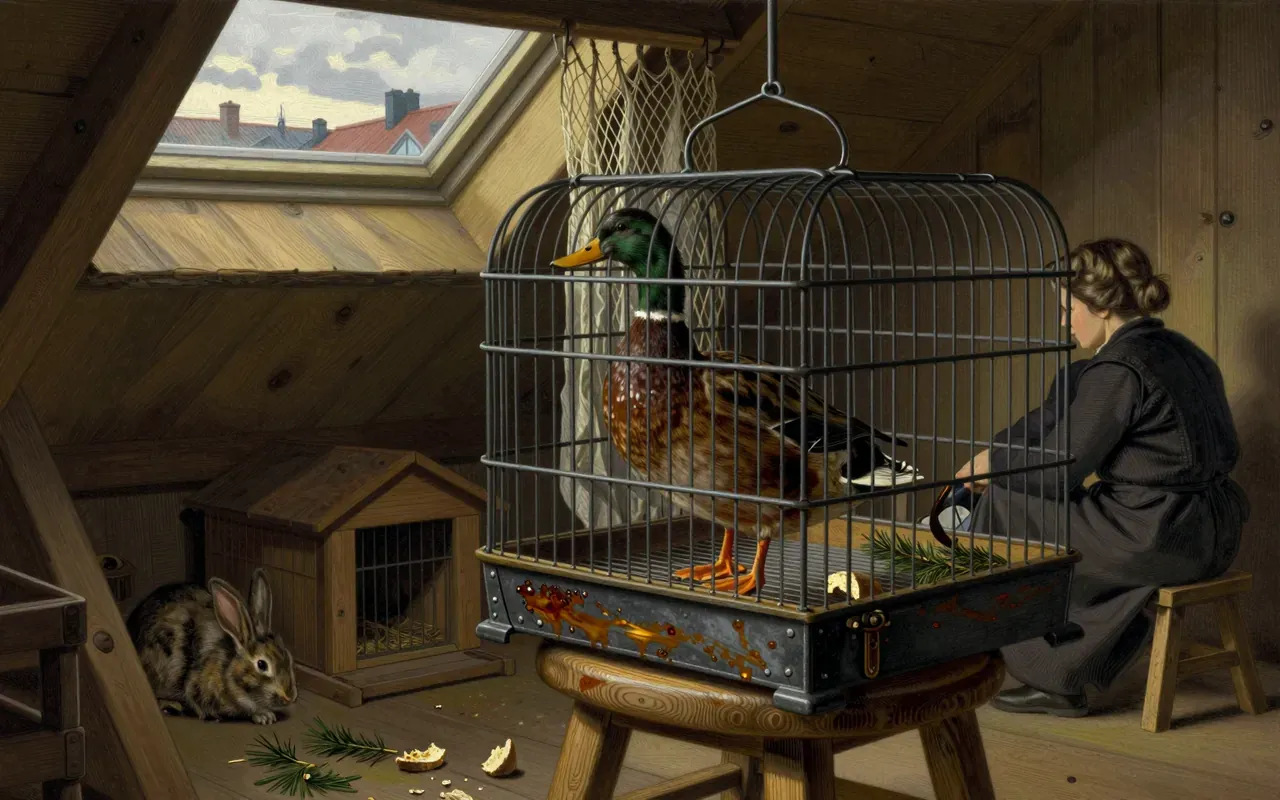
The loft is a perfect, contained symbol: net-and-sail curtain, rabbit hutches, pine boughs, the duck in its cage. Every prop is named and used. Gina’s line ‘I don’t know’ lands with physical weight because it follows seventeen years of silence. Relling’s ‘life-lie’ speech (Act V) is the play’s pivot—not exposition, but diagnosis.
What does not
It fails to grant Hedvig agency beyond sacrifice. Her death is framed as devotion, not resistance. Gregers’ idealism is never examined as class privilege—only as moral error. The play gives Werle Sr. no interiority, only function: he exists to be accused. It offers no structural critique of the society that makes Gina’s pragmatism necessary.
The themes
The play turns on illusion as necessity, not weakness. It treats paternal certainty as fiction, photography as failed realism, and the loft as a deliberate, collective fabrication. Hedvig’s blindness threat is never medical—it is symbolic: she sees too clearly what others must not. The annuity letter from Werle is not generosity; it is the final proof that money sustains the lie.
Who should read it
Readers who want to see how a single lie—Gina’s past with Werle—structures an entire family’s economy, space and language. Those studying Scandinavian realism, theatrical symbolism, or the ethics of truth-telling in intimate relationships.
Who should not
Readers expecting psychological realism about Hedvig’s inner life. Those seeking narrative resolution: Hjalmar does not change, Gina does not leave, Relling does not act. Anyone who believes ‘truth sets you free’ without examining whose freedom it serves.
The assessment
The play argues that truth destroys more than it liberates. Gregers Werle’s insistence on exposing Gina’s past and Hedvig’s paternity shatters Hjalmar’s self-image, paralyses Old Ekdal, and kills Hedvig. Relling’s ‘life-lie’ is not a concession—it is the play’s central claim. The wild duck is not metaphor; it is a wounded, living thing in the loft, kept alive by illusion and fed bread crusts. Ibsen names no alternative to the lie.
Is it worth your time
Yes—if you read it once, aloud, in under two hours. Skip no act, but watch for where silence falls: after Gina’s confession, before Hedvig picks up the pistol, when the duck’s wings beat against the cage in Act II. This is not a play about ideas. It is about the sound of a child loading a gun.